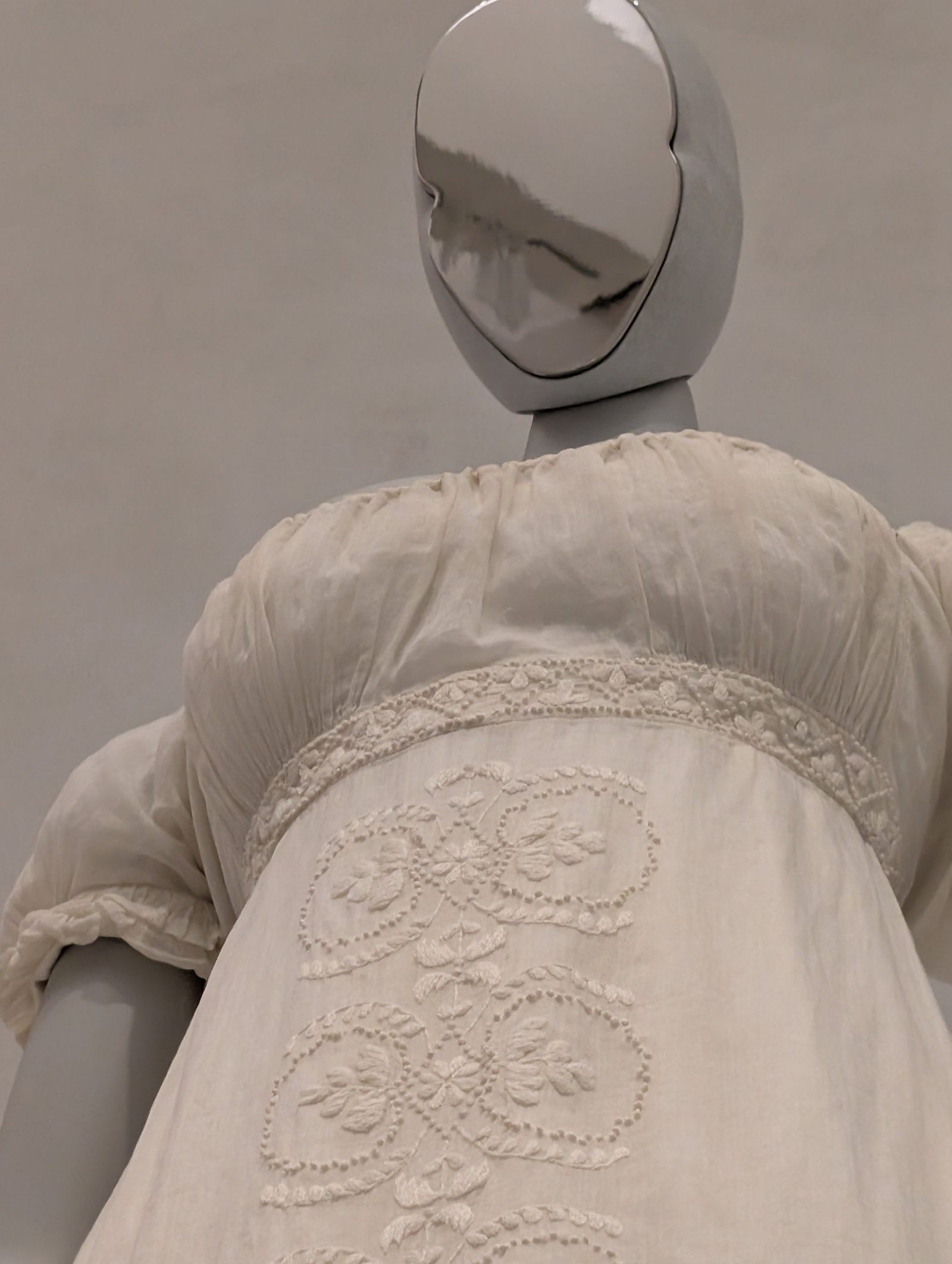

With this dress, its exquisite decoration does not immediately catch your eye. At first, you take in the classic neoclassical silhouette: a long, slender white skirt, a high waistline set just under the bust, and short puffed sleeves. Only upon looking closer do you discover the delicate embroidery: it streams down the center of the bodice and skirt in a neat vertical band, blossoming into a rich floral border along the hem. In close-up photographs, you catch yourself admiring every leaf, blossom, and delicate embroidered scroll.
This French Empire-style gown, dated to 1804–1805, comes from the collection of The Metropolitan Museum of Art. According to the museum label, it is crafted from sheer white cotton muslin and embroidered by hand with white cotton thread.
Whitework: The Magic of Monochromatic Texture
There are no contrasting colors here, the pattern emerges purely through the texture of the threads and the play of light across the delicate weave. From a distance, this embroidery (whitework or broderie blanche) appears subtle and understated, but up close, the density of the lower skirt’s ornament is striking.
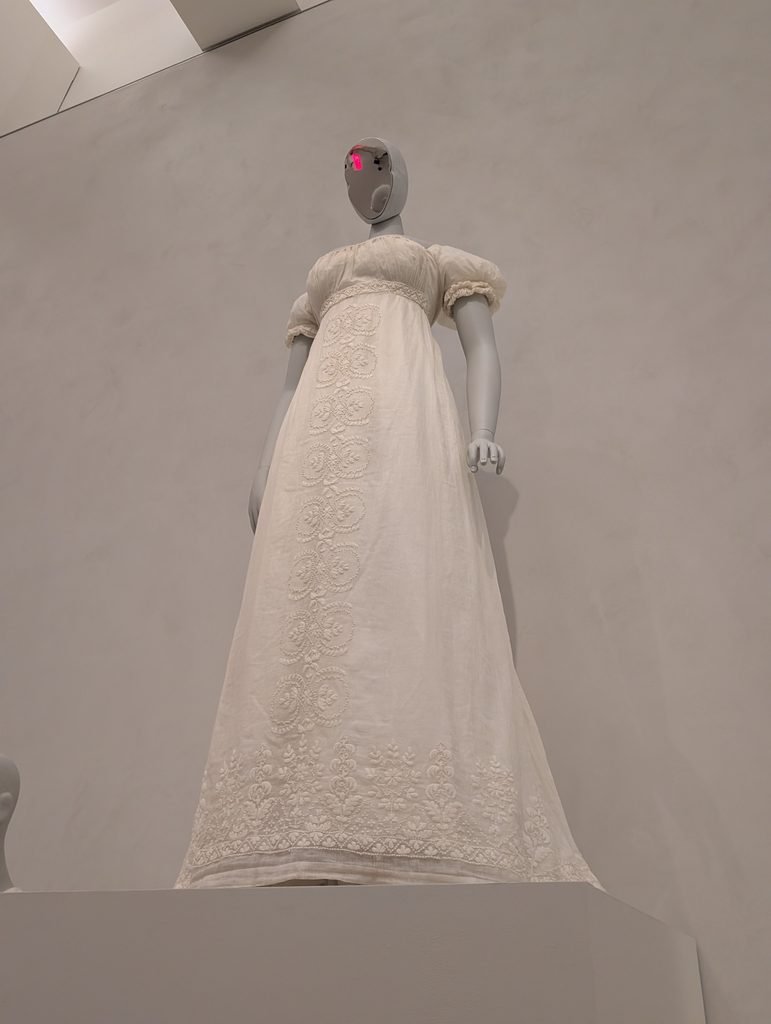
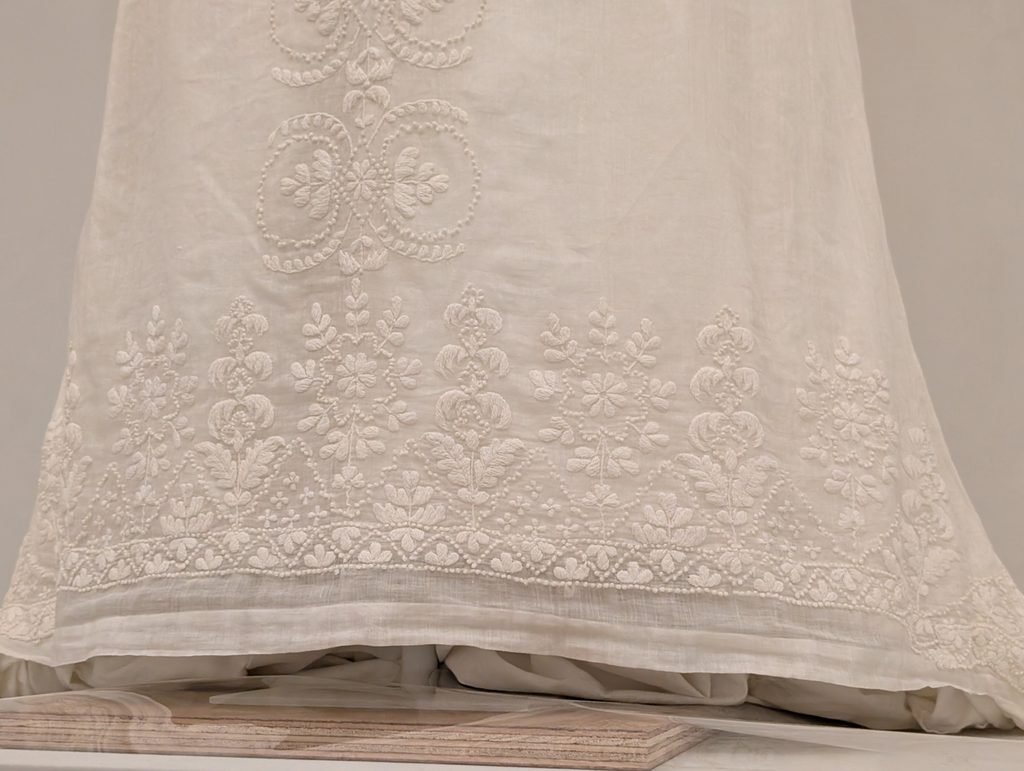
French, 1804-5
White cotton muslin embroidered with white cotton thread
Purchase, Gifts in memory of Elizabeth N. Lawrence, 1983 (1983.6.1)
Floral motifs form a wide, lavish border along the hemline, leaving a generous expanse of airy, plain muslin above it. This breathing space allows the delicate graphics of the pattern to stand out cleanly.
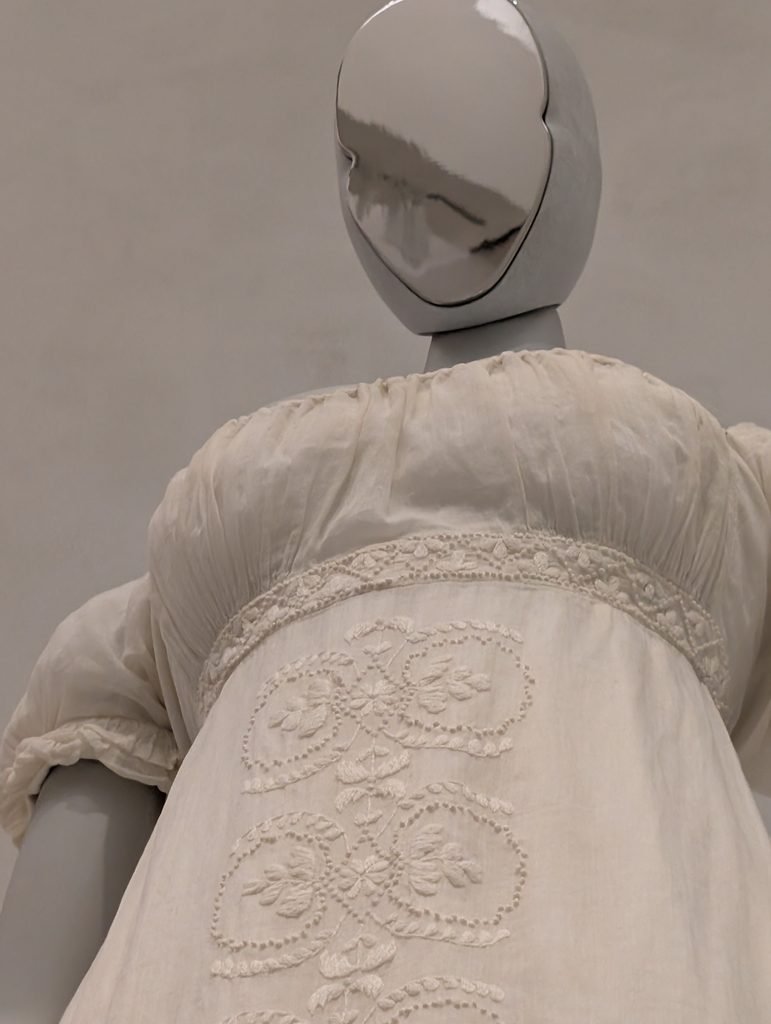
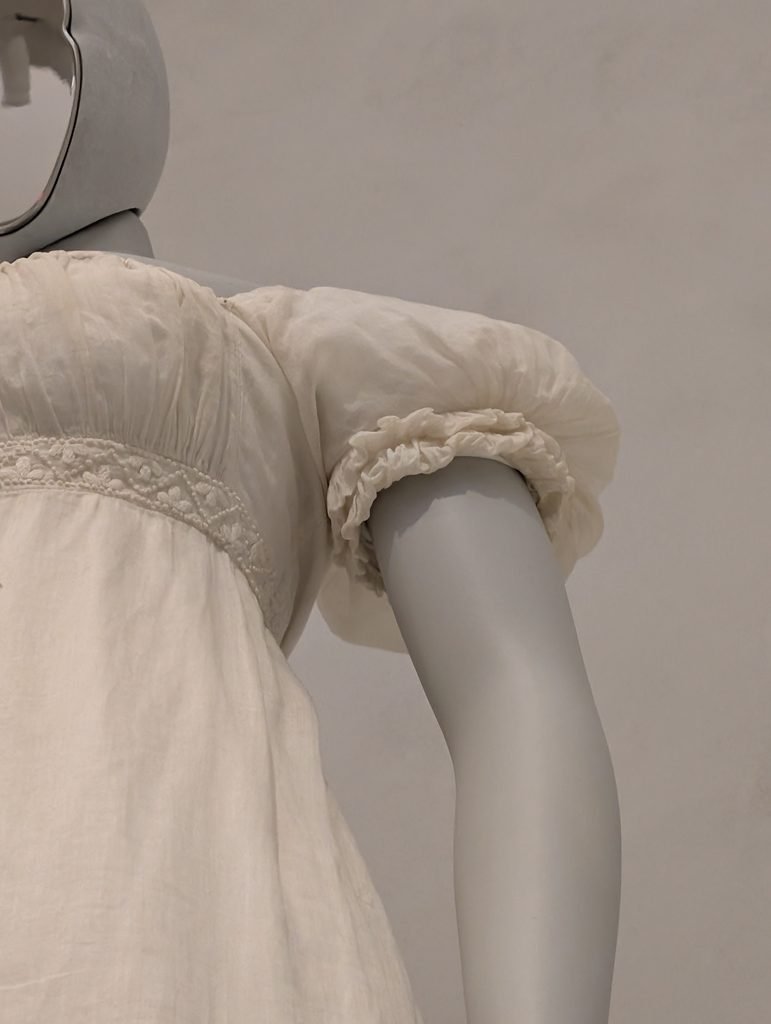
French, 1804-5
White cotton muslin embroidered with white cotton thread
Purchase, Gifts in memory of Elizabeth N. Lawrence, 1983 (1983.6.1)
A narrow embroidered band runs beneath the bust, neatly separating the short, gathered bodice from the long skirt. The short puffed sleeves feature soft gathers and a fine embroidered edge along the cuff. Placed beside the elaborate hem, these details feel harmonious and balanced: every element has its place without cluttering the clean, architectural line.
Airy Sheerness and Structural Undergarments: Was Empire Fashion Really Transparent?
The museum text connects early 19th-century muslin dresses like this one to the era’s fascination with classical antiquity. Their elongated silhouettes and lightweight fabrics directly referenced marble statues and classical Greek drapery.
However, what fashion enthusiasts viewed as the height of elegance, contemporary caricaturists quickly turned into a favorite subject for satirical humor. Satirists were especially fixated on the semi-transparency of muslin and a silhouette that allegedly revealed too much of the body beneath.
Yet “allegedly” is the crucial word here. As explained by The Met’s curators, women wore short stays (corsets) and multiple petticoats beneath these neoclassical dresses. These undergarments provided the necessary shape while significantly reducing the transparency of the sheer muslin. The idea that Empire-era women walked the streets wearing nothing but a single layer of thin fabric is more a product of satirical media than a reflection of daily life.
Three Graces Caught in a Gale
Displayed beside the muslin dress in the gallery is a famous print by British caricaturist James Gillray, titled The Graces in a High Wind, a Scene taken from Nature in Kensington Gardens, dated May 28, 1810.
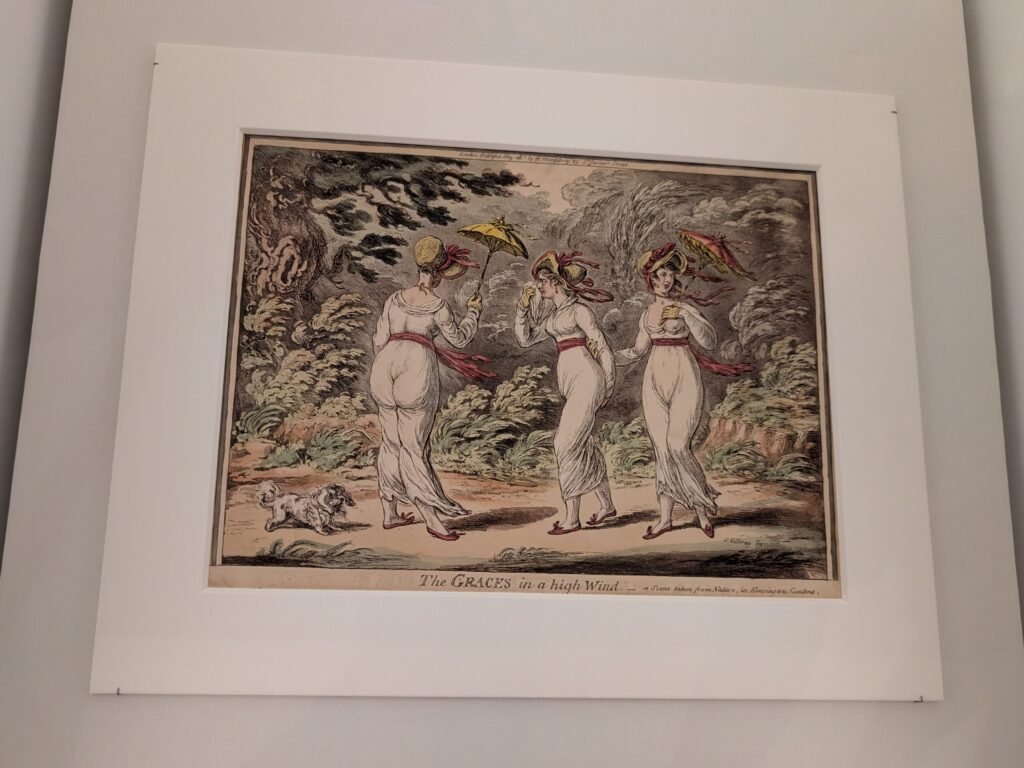
The Graces in a High Wind-a Scene taken from Nature in Kensington Gardens, May 28, 1810
Hand-colored etching, engraving, and aquatint
Gift of Jill Spalding, 2022.
In this hand-colored print, three fashionably dressed women stroll through a windy park. Gusts of wind press their sheer dresses against their bodies, a device the artist uses to exaggerate the transparency and revealing nature of their attire.
The title itself carries a playful irony. Gillray compares London fashionables to the Three Graces of Greek mythology, who were traditionally depicted nude or loosely draped in sheer cloth. It’s an amusing parody of neoclassical ideals: if women wished to look like classical goddesses, the satirist offered his own humorous interpretation of that resemblance.
What Caricature Leaves Out
In Gillray’s print, it appears as though the women have no undergarments at all beneath their thin dresses. However, the museum commentary explicitly cautions against taking this depiction literally. A true Regency or Empire silhouette was created through a complete ensemble of structural undergarments, not just a single layer of sheer muslin.
At the same time, arms and necklines were indeed left exposed. The satirist did not fabricate everything from scratch; rather, he took a noticeable fashion trend and pushed it to a comedic extreme.
Standing before this pair of objects, the contrast between an authentic garment and its satirical reflection is striking. The caricature invites us to laugh at the transparency of muslin, while the physical dress commands us to pause and appreciate the hundreds of hours of fine hand needlework behind its intricate design.
What I Look at as a Doll Clothes Artisan
For a doll clothing maker, working with whitework on an Empire dress is a lesson in miniature proportion and fabric choice.
- Muslin Alternatives: In doll scale, standard cotton muslin can feel bulky. To capture this weightlessness, fine silk chiffon, featherlight cotton batiste, or antique silk gauze are ideal alternatives.
- Miniature Whitework: Recreating such a delicate floral border in 1:6 or 1:4 scale can be achieved using single-strand silk thread embroidery or by sourcing fine antique cotton lace with a similar botanical motif.
- High Waist & Micro-Gathers: The band under the bust needs to be ultra-narrow, with microscopic, neatly pressed gathers on the skirt to avoid adding unwanted bulk to a miniature waistline.
Object Details
- Dress:
- Date: 1804–1805
- Culture: French
- Medium: White cotton muslin embroidered with white cotton thread
- Credit Line: Purchase, Gifts in memory of Elizabeth N. Lawrence, 1983
- Accession Number: 1983.6.1
- Print (The Graces in a High Wind):
- Date: May 28, 1810
- Artist: James Gillray (British, 1756–1815)
- Medium: Etching, engraving, and aquatint, hand-colored
- Credit Line: Gift of Jill Spalding, 2022
- Accession Number: 2022.309.5
- Department & Exhibition: The Costume Institute, Costume Art Exhibition, The Metropolitan Museum of Art, New York
Sources & Further Reading
- Dress (1804–1805) — The Metropolitan Museum of Art, Accession Number: 1983.6.1[cite: 3].
- The Graces in a High Wind—a Scene taken from Nature in Kensington Gardens (1810) — James Gillray, The Metropolitan Museum of Art, Accession Number: 2022.309.5[cite: 3].
- Costume Art — Exhibition materials & gallery label texts, The Costume Institute, The Metropolitan Museum of Art, New York[cite: 3].
- Neoclassical Muslin & Whitework Embroidery — History of French Empire fashion, broderie blanche, and Regency undergarments in early 19th-century dress[cite: 3].