
Moving past frozen ancient canons and “wet” drapery, the next section of Costume Art at The Met, Abstract Body, offers a fundamentally different perspective on the silhouette. Here, clothing no longer attempts to reveal natural anatomy. Instead, it constructs its own: cinching the waist, exaggerating the hips, projecting the skirt backward, or sculpting curves where you least expect them.
Behind the section’s scholarly title lie very tangible components: linen stays, cane hoops, steel springs, padded bustles, and dozens of yards of fabric. For anyone working with textiles and pattern drafting, it is a true masterclass: behind every striking silhouette stands a deliberate engineering design.
The 18th Century: A Tapered Cone and Panoramic Width
In the mid-18th century, fashionable women’s silhouettes relied on the contrast of two geometric forms: a rigid conical torso and a broad, nearly rectangular skirt.
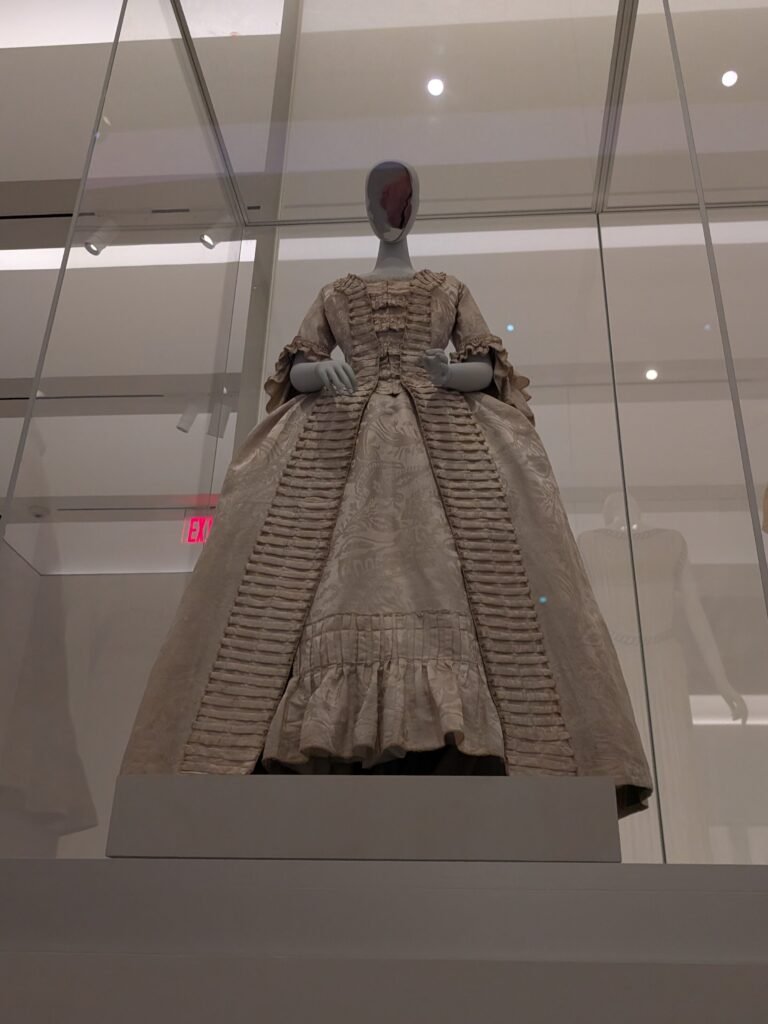
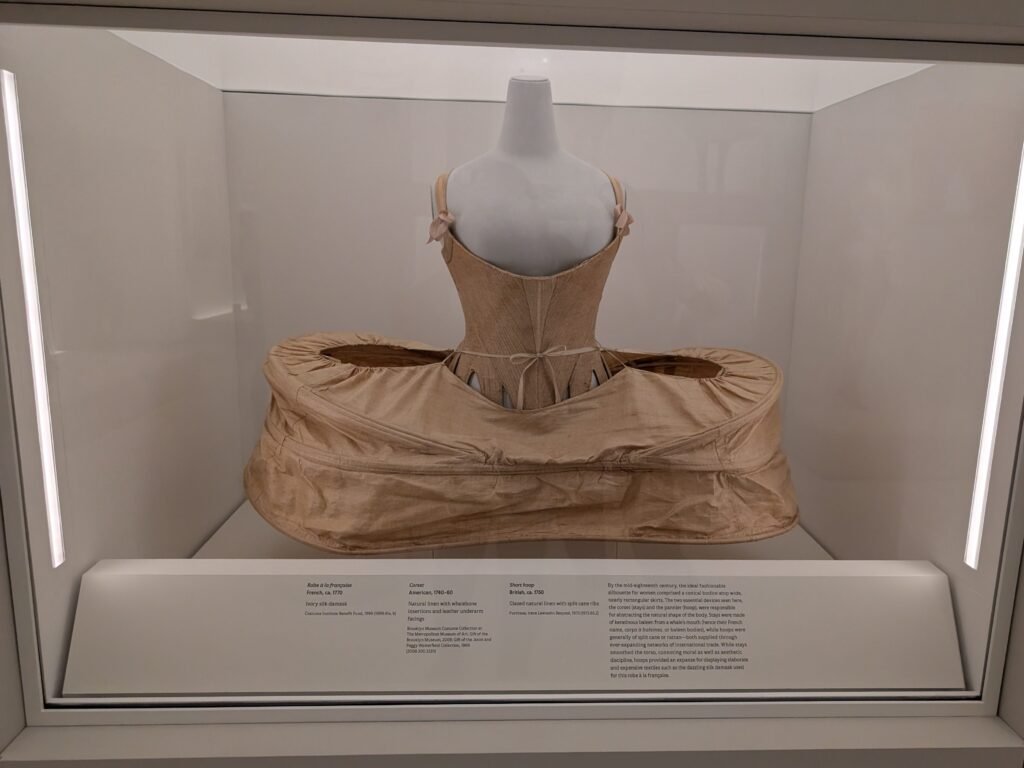
The exhibition breaks this formula down into its core components: a French robe à la française (c. 1770), a linen corset (stays) structured with baleen boning and leather armpit guards (1740–1760), and side-hoop frames (panniers) made from split cane (c. 1750).
French, ca. 1770
A French robe à la française (c. 1770) displayed in a glass case at The Met.
For makers, this extreme skirt width is easy to understand: it served as an ideal canvas. Luxurious silk damask was not lost in fine gathers; instead, it unfolded before the viewer like a grand decorative panel.
American, 1740–60
Short hoop
British, ca. 1750
Linen stays (1740–1760) paired with side-hoop pocket frames (panniers / pocket hoops, c. 1750).
Playing with Proportions: From Balenciaga to Vivienne Westwood
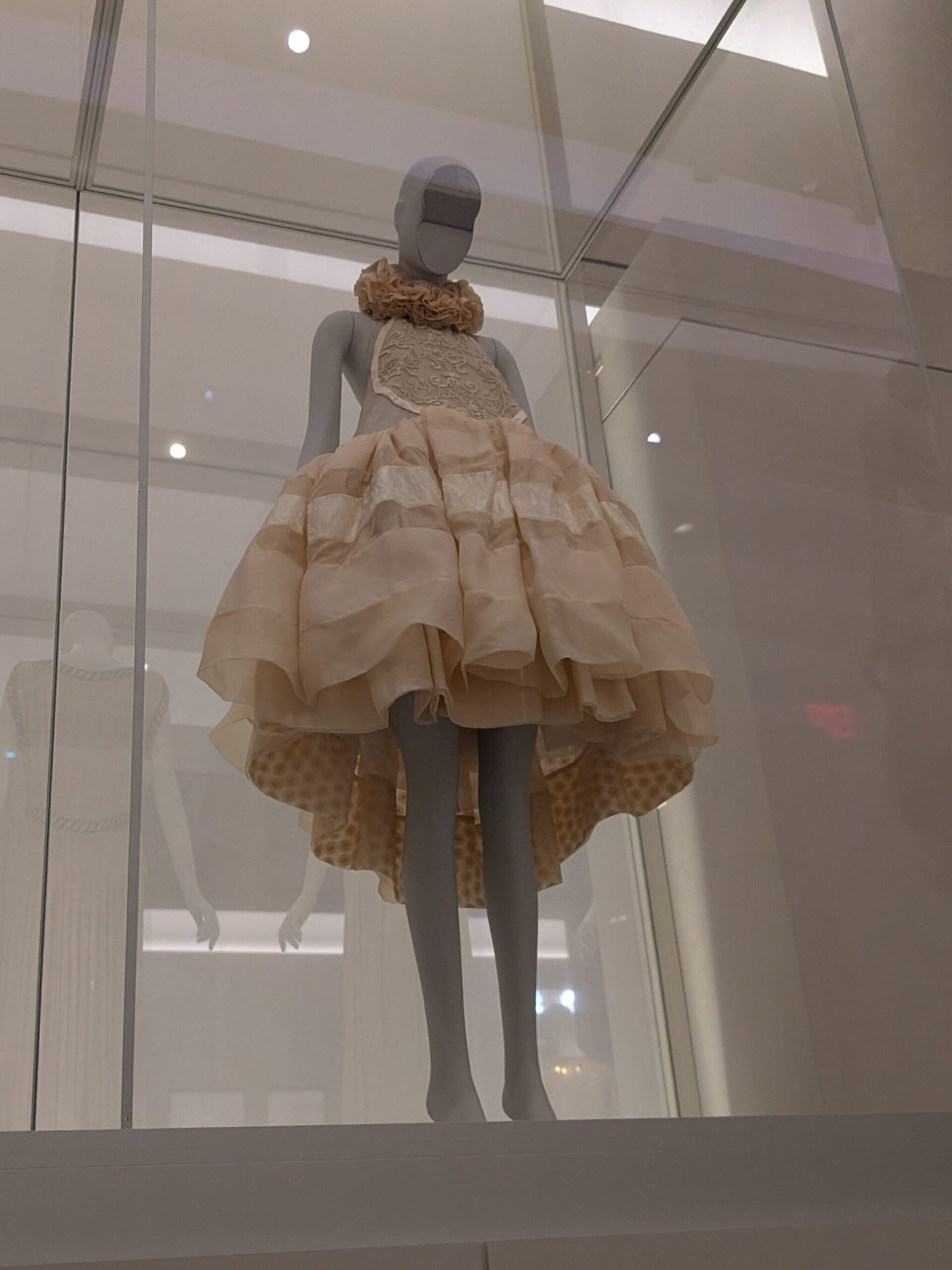
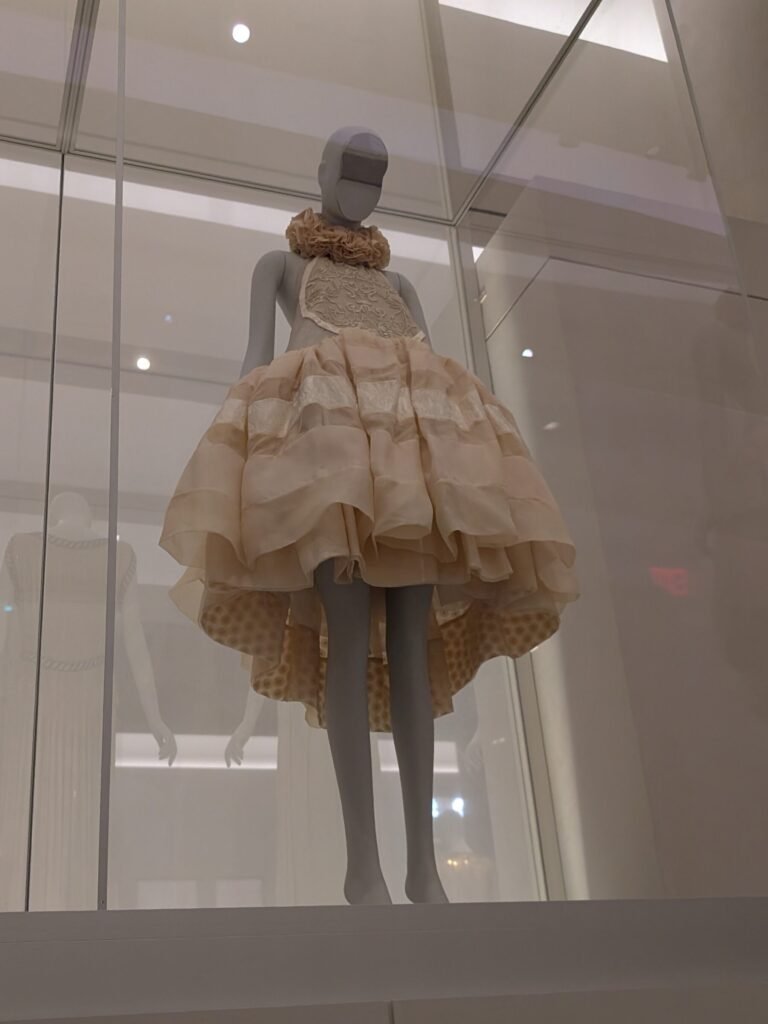
Modern couturiers continually turn these hidden foundational structures inside out. Nicolas Ghesquière, in his Spring–Summer 2006 collection for Balenciaga, transformed hidden hoops into visible embellishment: bands of silk gazar and satin jacquard themselves form a tiered cage.
Nearby, Maria Grazia Chiuri (Dior, Spring–Summer 2023) references 16th-century farthingales associated with Catherine de’ Medici as a way to control the space surrounding the body, while Vivienne Westwood radically shifts proportions by pairing a corseted top with a crinoline scaled down to the length of a ballet tutu.
Design House House of Balenciaga French
Designer Nicolas Ghesquière British
spring/summer 2006
A modern reinterpretation of structural framing: a Balenciaga gown (2006) alongside a mini-crinoline by Vivienne Westwood.
Crinolines and Bustles: Supporting the Weight of Fabric
In the 19th century, underskirts evolved from heavy, starched layers to a lightweight cage made of metal hoops joined by fabric tapes (the patented cage crinoline of 1856). By 1867, however, this vast mass of fabric began shifting backward.
In a gown by Maison Vignon (1875–1878) crafted from heavy brocade, velvet, lace, and glass beads, the rear volume is supported not merely by gathers, but by a patented bustle featuring flexible spiral springs (1873).
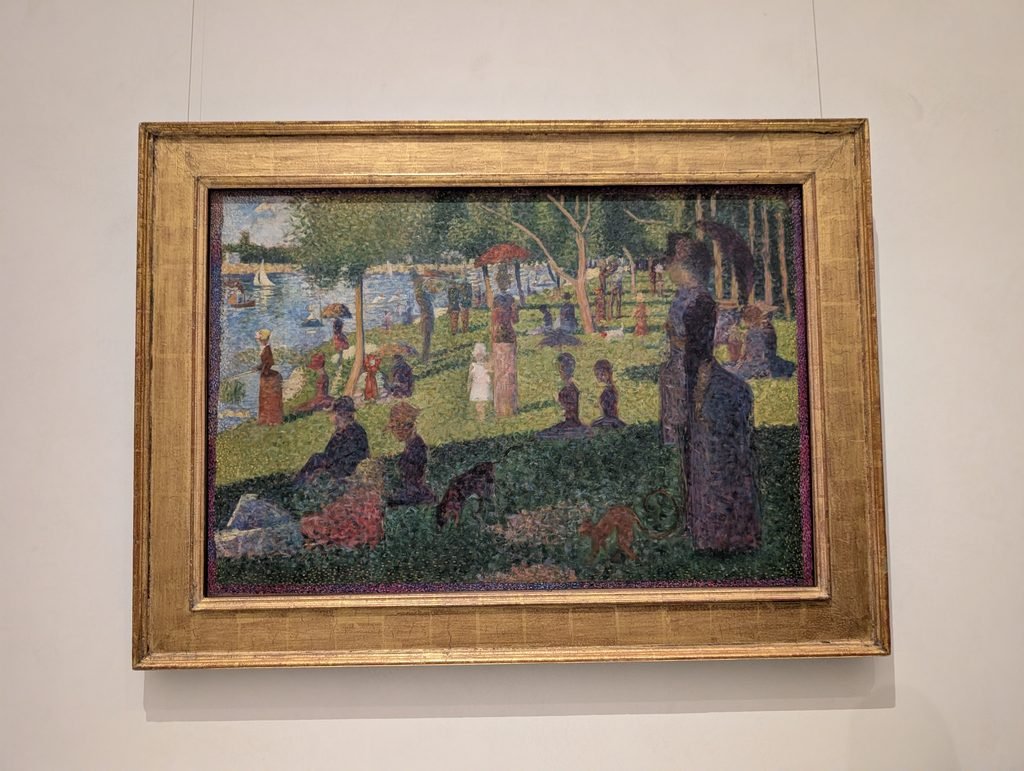
Georges Seurat
1884
The bustle reached its near-perpendicular extreme around 1885. Painter Georges Seurat, in his study for A Sunday on La Grande Jatte (1884), approached this dramatic protrusion not as a fleeting fashion trend, but as a bold geometric element for his composition.
Take a closer look at this bustle ensemble in our article, 1880s Walking Dress: Bustle, Velvet, and the Eye of Georges Seurat.
Charles James: Architecture Built on Unbleached Muslin
For pattern makers, one of the most compelling objects on display is not a finished evening gown, but Charles James’s black-and-white Bustle toile (1947), constructed from unbleached cotton.
The overskirt is gathered and tied just below the bustle projection. While it appears to be a light, spontaneous drape, the toile reveals rigorous engineering calculation: every slash, dart, and angle was fixed before precious silk ever touched the dress form.
What I Look at as a Maker
When analyzing these artifacts through the lens of doll making or custom tailoring, technical questions immediately come to the fore:
- Source of Volume: Where exactly is the shape established, within the pattern cut, the gathers, or a separate internal cage?
- Material Support: What holds the silhouette, baleen, steel springs, stiff net, or internal padding?
- Weight Distribution: Why doesn’t heavy brocade collapse under its own weight?
- Role of the Toile/Muslin: Which structural lines are visible in raw form before surface embellishment is added?
Abstract Body compellingly demonstrates that garments can either faithfully follow the human form or completely rewrite it using architectural rules. And every single one of these transformations begins with precise calculations on paper and fabric.
Sources & Further Reading
- The Metropolitan Museum of Art. Costume Art Exhibition Catalog & Wall Texts (May 10, 2026 – January 10, 2027).
- Koda, Harold. Extreme Beauty: The Body Transformed. New York: The Metropolitan Museum of Art, 2001.
- Waugh, Norah. Corsets and Crinolines. Routledge, 2015 (reprint).
- Arnold, Janet. Patterns of Fashion 1: Englishwomen’s Dresses & Their Construction C. 1660-1860. Macmillan, 1977.
- Martin, Richard, and Harold Koda. Charles James: Beyond Fashion. The Metropolitan Museum of Art, 2014.
- Steele, Valerie. The Corset: A Cultural History. Yale University Press, 2001.