
In this section of The Met’s exhibition, garments from vastly different eras sit side by side: pale early 20th-century corsets, an 1880s red satin gown, a 1950s black dress by Charles James, and a contemporary Dior corset embroidered with an image of an unborn child.
Together, they tell a story that goes beyond maternity wear. They trace how the very concept of the visible female body evolved: from attempts to cinch and shape it, to hiding and balancing it with draped folds, granting it room to expand, and ultimately turning it into the central motif of an embroidery design.
It is easy to overlook this in photographs at first glance. You see beautiful creations: rich red satin, black silk, lace, fasteners, and a delicate bow. But then, you begin to look closer and examine them as constructions.
A Corset Designed to Evolve with the Body
This light-colored corset with long laces was made by the American firm The H. & W. Company around 1908. Its clever cut, lacing, and fasteners provided the necessary flexibility. According to The Met, it was worn during pregnancy and adapted for nursing after childbirth.
What look like complex vintage details were actually functional: allowing the corset to adjust as the body changed. Yet beneath this practicality lay the rigid expectation of the era: even a pregnant body was expected to maintain a fashionable silhouette. Designed for working- and middle-class women who nursed their own children, it reveals just how indispensable corsetry was considered in everyday life.
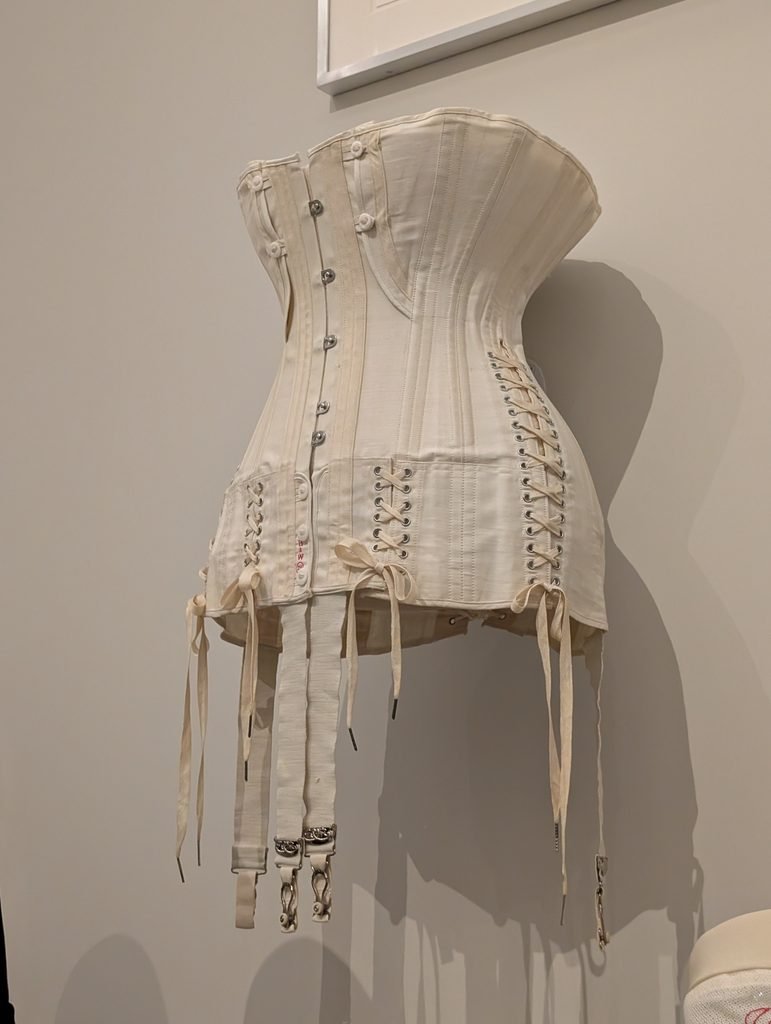
Manufacturer The H. & W. Company American, ca. 1908.
A Bow Accent and Extra Freedom
The second corset, dated to around 1902, is attributed to the American Royal Worcester Corset Company. It features a front busk closure, narrow vertical boning channels, a delicate lace trim, and a small decorative bow at the top edge.
However, the real secret lies in its clever construction. Built from four panels, it incorporates extra sets of eyelets, back lacing, and generous elastic inserts across the front. The Met notes that this was likely a maternity corset, designed to be gradually loosened as the abdomen expanded throughout most of the term.
The bow is merely a charming touch, the true brilliance of this piece is its hidden adjustability, easily missed behind the museum glass.
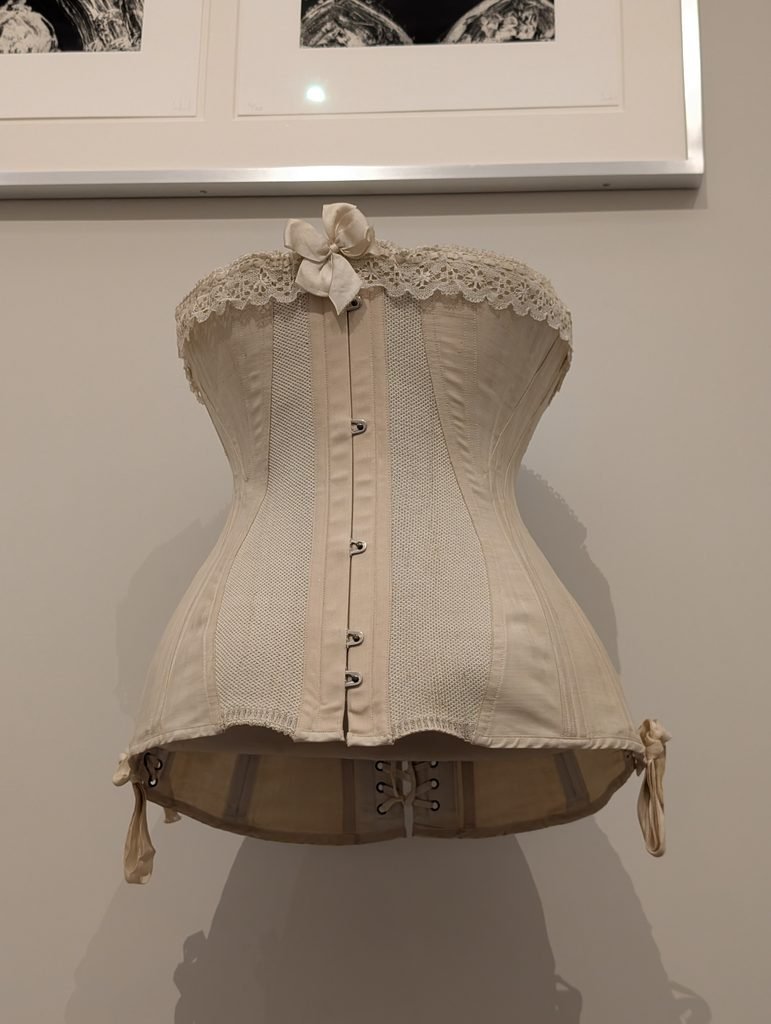
Manufacturer Attributed to Royal Worcester Corset Company American, ca. 1902
From Crinolines to Corsets
The history of the Royal Worcester Corset Company mirrors the evolution of the female silhouette.
Founded in 1861 as The Worcester Skirt Company to make hoop skirts, the firm shifted to corsets as fashion moved from volume around the hips to a shaped torso, becoming the Royal Worcester Corset Company in 1901. Essentially, they transitioned from shaping space around the body to shaping the body itself.
In 1950, its historic 171-piece corset archive was gifted to the Brooklyn Museum, later entering the collection of The Met.
A Red Gown for Public Life
This red silk gown from around 1882 was neither loungewear nor an attempt to fade into the background. The Met classifies it as a high-style maternity dress, an elegant gown designed specifically for social appearances.
It commands attention with its rich wine-red satin, fitted long sleeves, darker bodice trim, side draping, and a dramatic bustle at the back. Everything about it says high fashion rather than a “special need” garment.
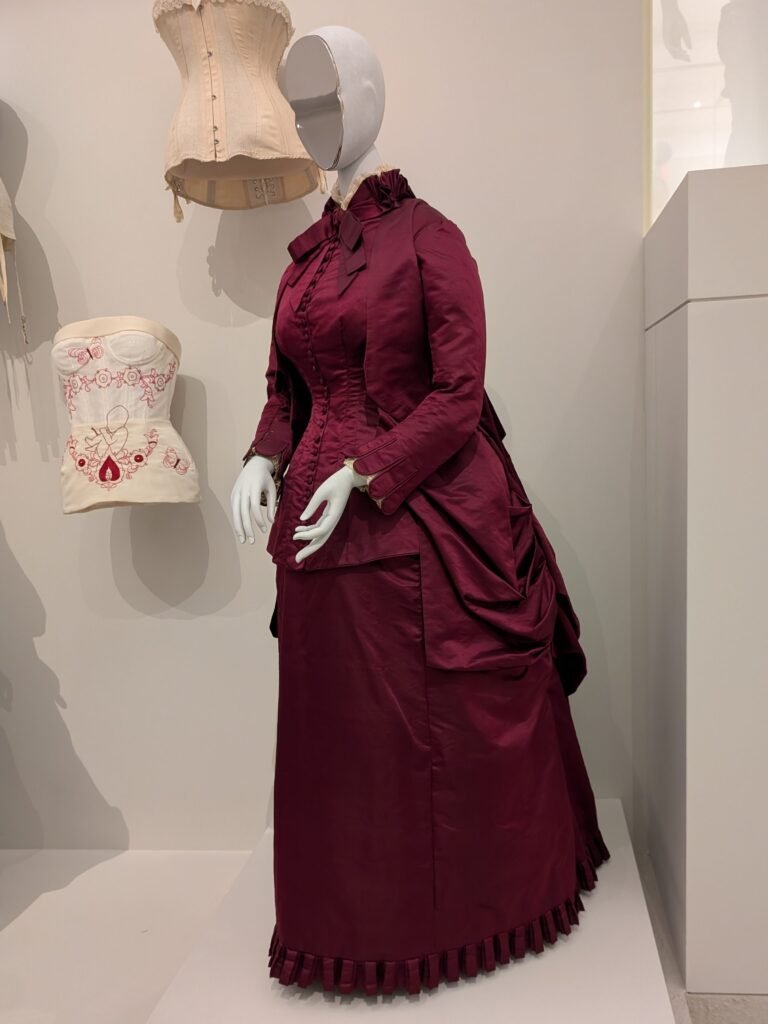
probably American, ca. 1882.
To craft it, 19th-century dressmakers cleverly pulled historic references from earlier eras:
- Watteau pleats: Cascading folds falling from the shoulders, reminiscent of 18th-century gowns made famous by painter Antoine Watteau.
- Polonaise draping: Sweeping volume gathered at the back.
- Piccadill tabs: Decorative notched cuffs inspired by Elizabethan fashion.
These historic references were more than decorative, the sweeping fabric and draping at the back strategically counterbalanced the changing proportions in front. The gown did not conceal pregnancy, but ensured it wasn’t the only thing people noticed.
Charles James’s Black Gown
Nearby sits a black silk faille gown (ca. 1950) by Charles James, featuring a striking silhouette with a soft, rounded front volume.
This design served as the blueprint for a maternity version James developed for Lane Bryant. In that adaptation, the outer silk layer was paired with a taffeta underskirt flared from beneath the bust to accommodate a growing belly.
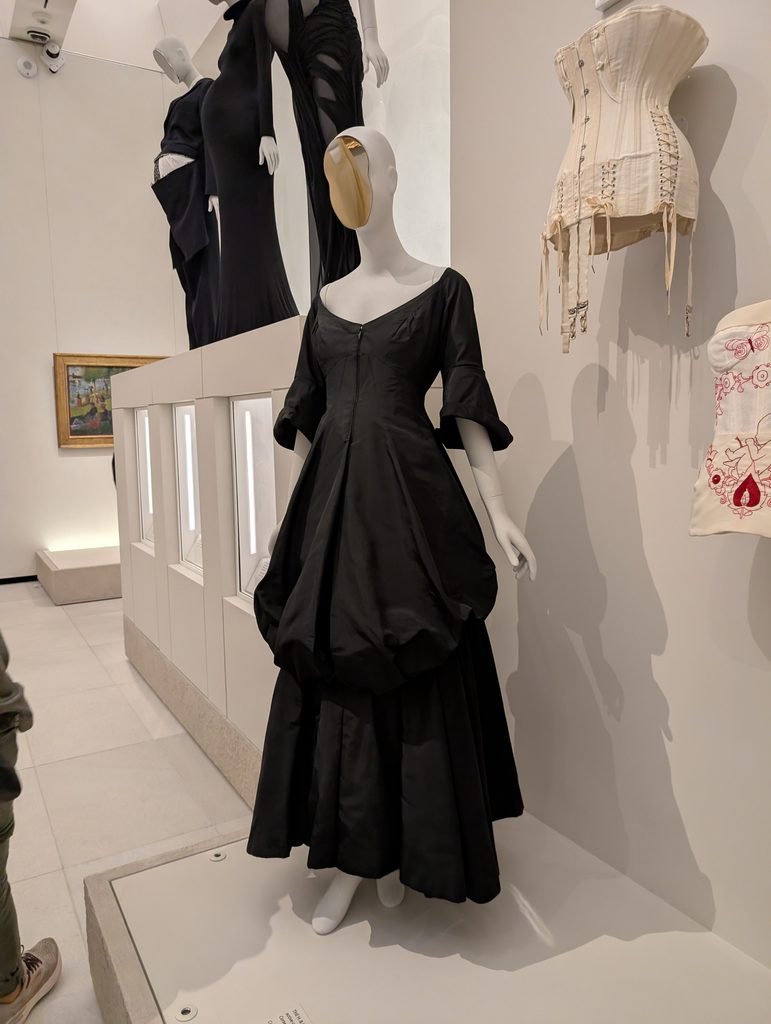
Designer Charles James American, ca. 1956.
To calculate the exact angle of the flare, James ran ribbons through staples on a wooden board, an almost engineering-like experiment. Yet the final mechanism was surprisingly simple: a raised horizontal seam encircling the skirt. By placing it higher at the back and lower at the front, he created a natural slope that seamlessly sculpted the needed volume.
The Belly Concealed No More
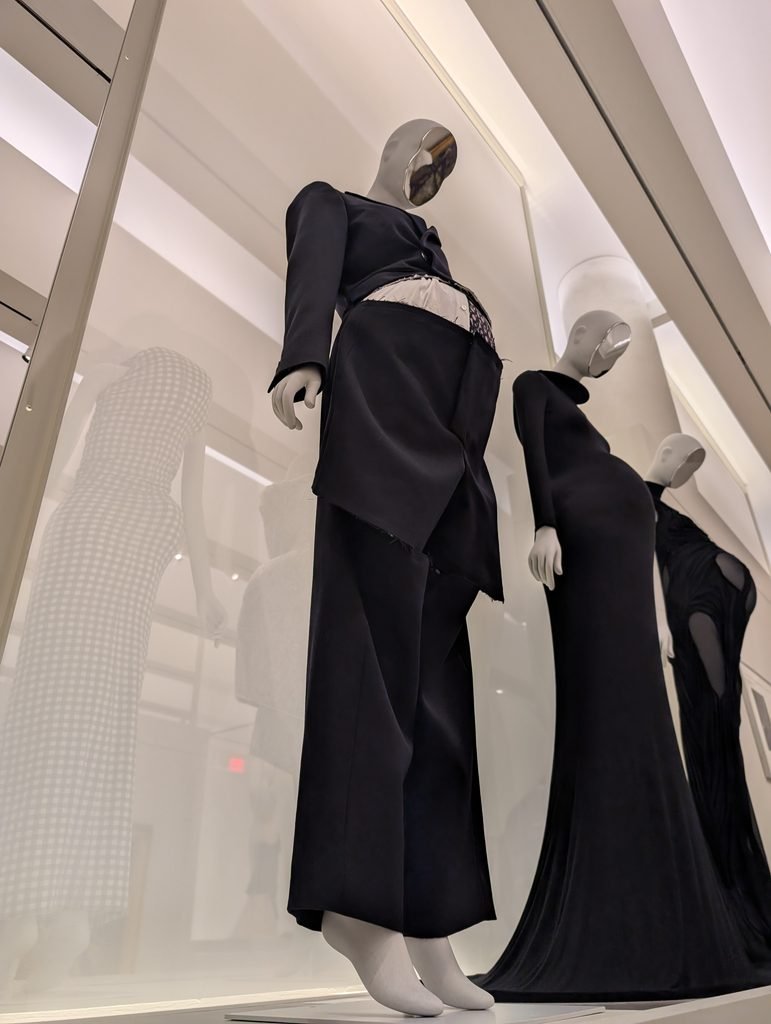
This photo highlights three distinct approaches to showcasing the altered form. Rendered entirely in black, the focus shifts purely to shape and structure: an open gap between top and waistband, the rounded contour of the belly, strategic cutouts, and long, sweeping lines.
Design House Comme des Garçons Japanese
Designer Rei Kawakubo Japanese
spring/summer 2019
“Pregnancy”
Designer Georgina Godley British
Design House Georgina Godley British
fall/winter 1986–87, edition 2025
Dress
Design House Di Petsa British
Designer Dimitra Petsa Greek
spring/summer 2023, edition 2025
The ensembles include a Comme des Garçons design by Rei Kawakubo (Spring–Summer 2019), Georgina Godley’s Pregnancy model from Autumn–Winter 1986–87 (re-executed in 2025), and a Di Petsa gown by Dimitra Petsa from Spring–Summer 2023 (also re-executed in 2025).
Comparing these to the 1880s red gown reveals a fascinating shift. While the Victorian dress used draped folds to counterbalance changing proportions within a traditional silhouette, these modern pieces embrace the belly’s fullness as the defining element of the design, framing, contouring, or directly revealing it.
The monochrome palette emphasizes this intent: without ornamental distractions, the silhouette speaks entirely for itself. What historical garments sought to contain or disguise has now become the central structural statement.
What Is Hidden No More
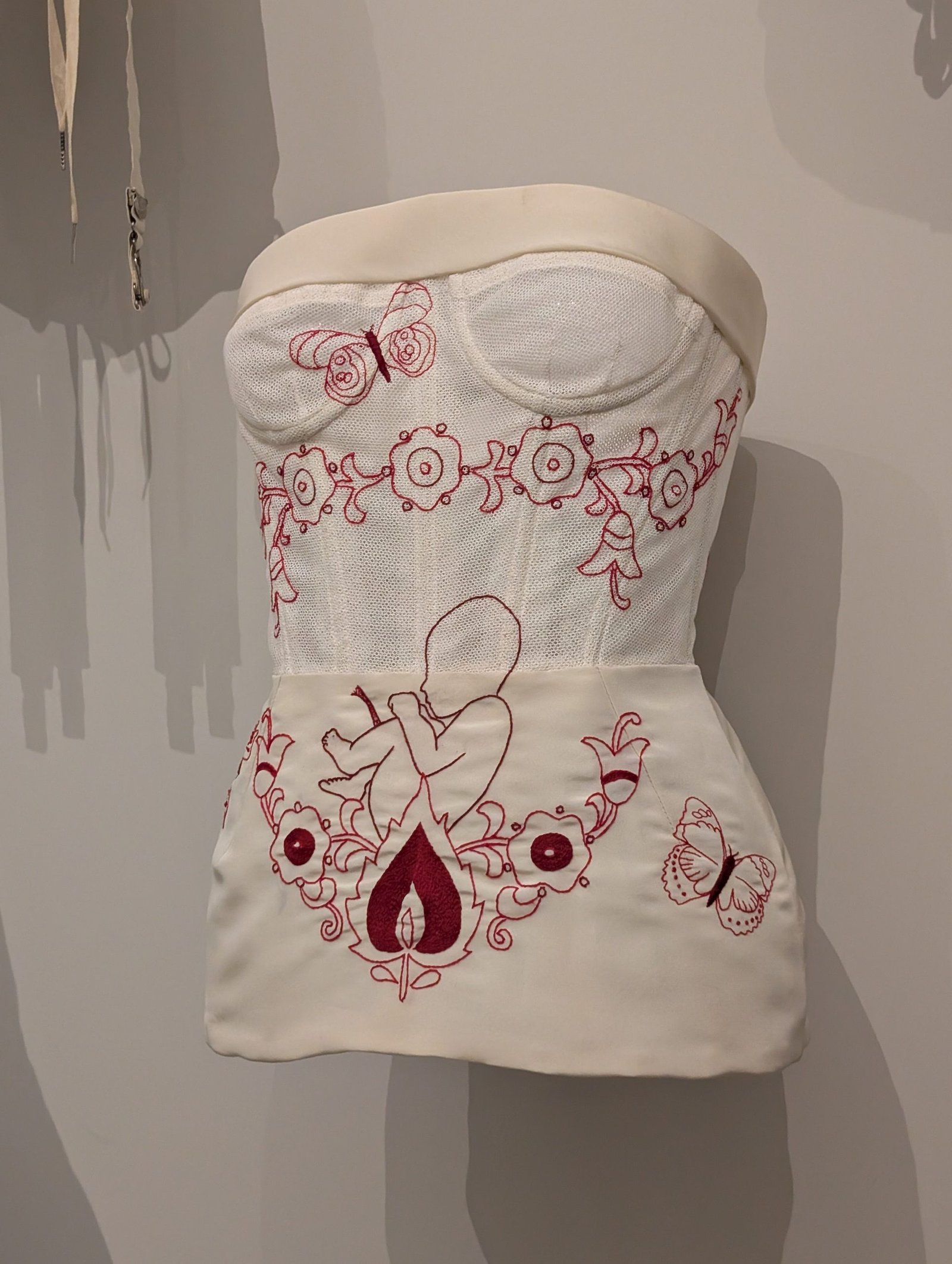
In the 2024 Dior corset, the theme of pregnancy is approached in a completely new light. On white cotton tweed and mesh, an unborn child is embroidered in red floss, encircled by floral scrolls and butterflies.
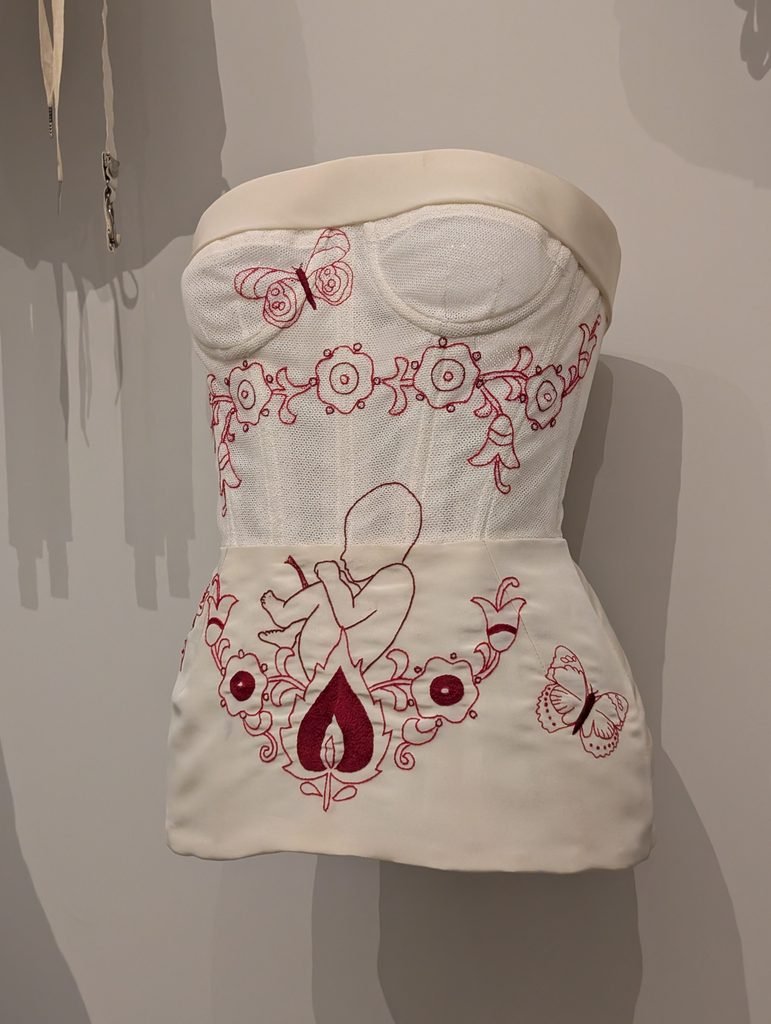
Created by Maria Grazia Chiuri for Dior in collaboration with Mexican artist Elina Chauvet, this piece makes no attempt to disguise pregnancy through draping, dark colors, or flexible boning. What was once concealed beneath layers of fabric is brought directly to the surface.
The Met connects this cultural shift to the rise of ultrasound technology in the mid-20th century. Pregnancy became literally more visible, and the embroidered fetus on the Dior corset transforms this visibility into a powerful aesthetic statement.
A Vessel Echoing the Pregnant Form
In this context, Turkish artist Elif Uras’s ceramic vessel, Pregnant Haliç II (2015), feels remarkably fitting. Its voluptuous form evokes a pregnant belly, while its blue-and-white spiral florals reference 16th-century Iznik ceramics from Istanbul’s Haliç (Golden Horn) district.
Uras collaborates in Iznik with local women artisans. In Ottoman times, ceramic production was strictly male-dominated; today, the Iznik Foundation is driven by women craftspeople and entrepreneurs.
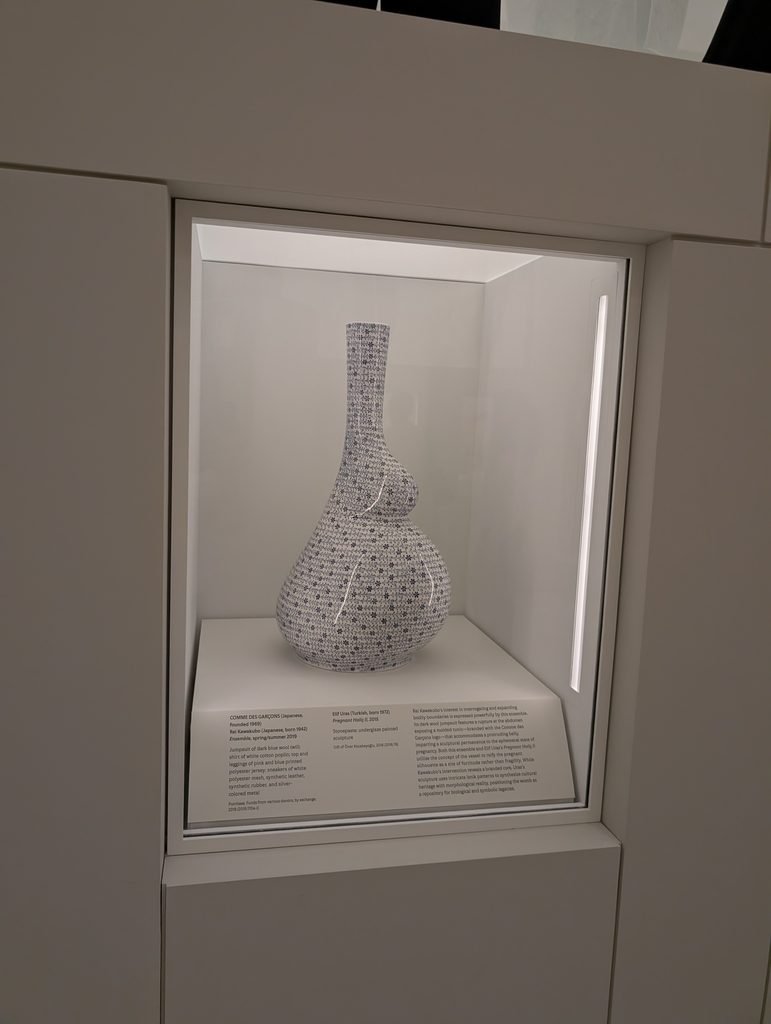
Elif Uras Turkish, 2015.
Pregnant Haliç II is more than a nod to historical pottery, it honors these women, placing the female form and female craftsmanship firmly at the center of ceramic history.
What I Look at as a Doll Clothes Maker
For a doll artisan, these historic pieces are a masterclass in structural engineering. Translating them to a miniature scale is all about managing tension and fabric bulk. The adjustable side-lacing on early corsets shows how to build flexible doll bodices, while the Watteau pleats and Charles James’s curved seams demonstrate how to sculpt and balance volume on a small frame.
Side by Side with Purpose
This gallery display offers no single, simple answer to what maternity clothing was. Instead, it reveals evolving attitudes toward a changing body.
Early corsets sought flexible shaping. The 1880s red gown allowed a woman to remain fashionable and visible. Charles James transformed extra volume into a complex sculptural form. The Dior corset turned the image of pregnancy into a central motif, while Elif Uras embodied the maternal form within the ceramic vessel itself.
Examining the seams, closures, pleats, and tiny bows reveals far more than fashion history, it captures how the lived experience of pregnancy was designed and worn.
Object Details
- Maternity Corset (ca. 1908): The H. & W. Company, USA; cotton, baleen, metal, elastic (Brooklyn Museum Costume Collection at The Met, 2009.300.2759a–g).
- Lace Maternity Corset (ca. 1902): Attributed to Royal Worcester Corset Company, USA; cotton twill, elastic mesh, silk ribbon, machine lace (Brooklyn Museum Costume Collection at The Met, 2009.300.3122a–g).
- Maternity Dress (ca. 1882): Attributed to USA; red silk satin (The Met, 1985.363.9).
- Dress (ca. 1956): Charles James; black silk faille (The Met, 2013.327).
- Haute Couture Corset (2024): House of Dior (Maria Grazia Chiuri & Elina Chauvet); white cotton twill, mesh, red embroidery (Courtesy of House of Dior).
Sources & Further Reading
- The Metropolitan Museum of Art (Costume Institute & Brooklyn Museum Collection):
- Maternity Corset (ca. 1908) — The H. & W. Company, Brooklyn Museum Costume Collection at The Met, Accession Number: 2009.300.2759a–g.
- Maternity Corset (ca. 1902) — Attributed to Royal Worcester Corset Company, Brooklyn Museum Costume Collection at The Met, Accession Number: 2009.300.3122a–g.
- High-Style Maternity Dress (ca. 1882) — Red silk satin gown with Watteau pleats, The Met, Accession Number: 1985.363.9.
- Black Silk Faille Dress (ca. 1956) — Charles James, design foundation for Lane Bryant maternity line, The Met, Accession Number: 2013.327.
- Contemporary Couture & Art at The Met:
- Haute Couture Corset (2024) — House of Dior, Maria Grazia Chiuri & Elina Chauvet, white twill with red embroidery.
- Pregnant Haliç II (2015) — Elif Uras, spiral floral ceramic vessel inspired by 16th-century Iznik pottery, The Met.