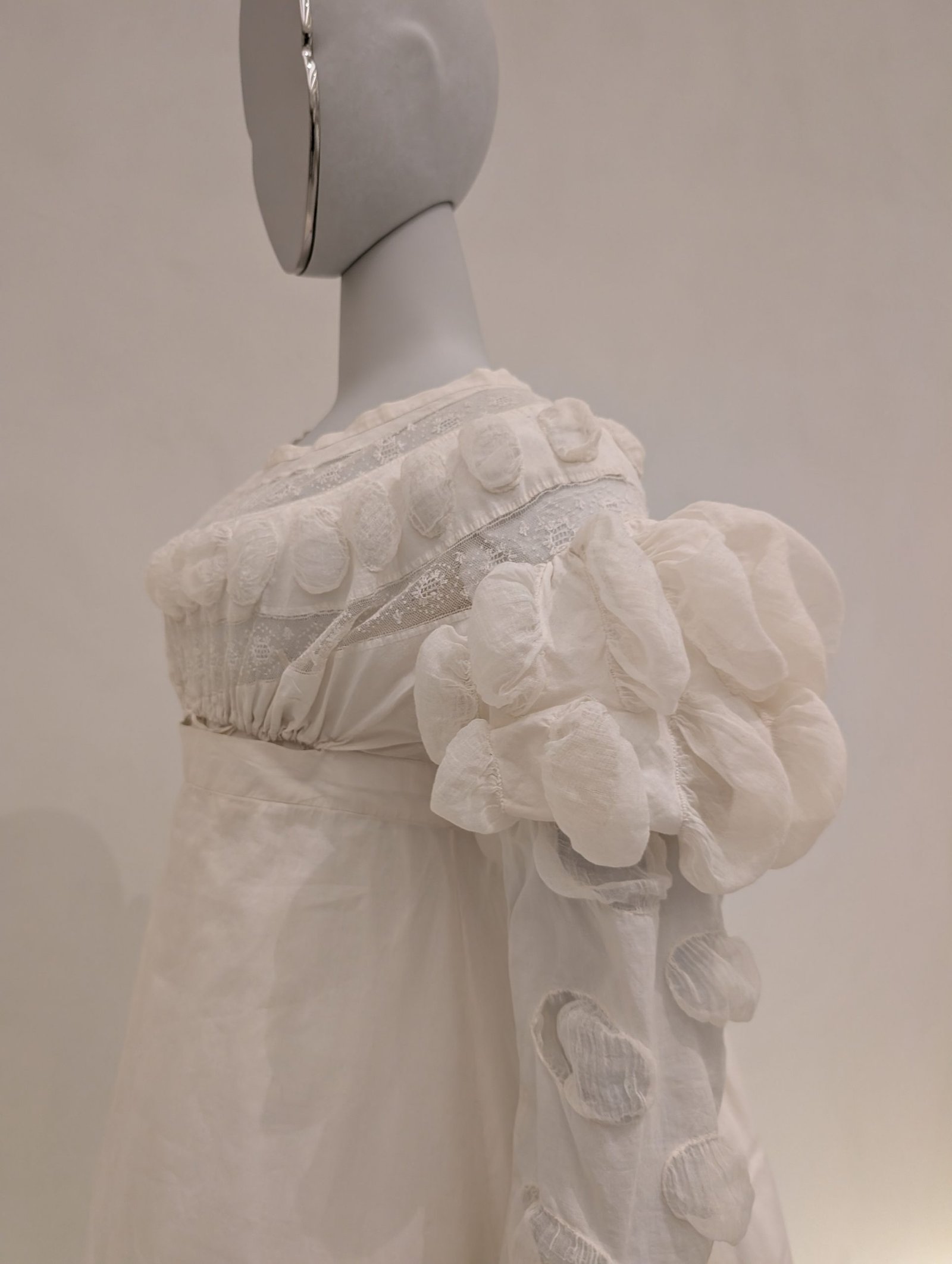

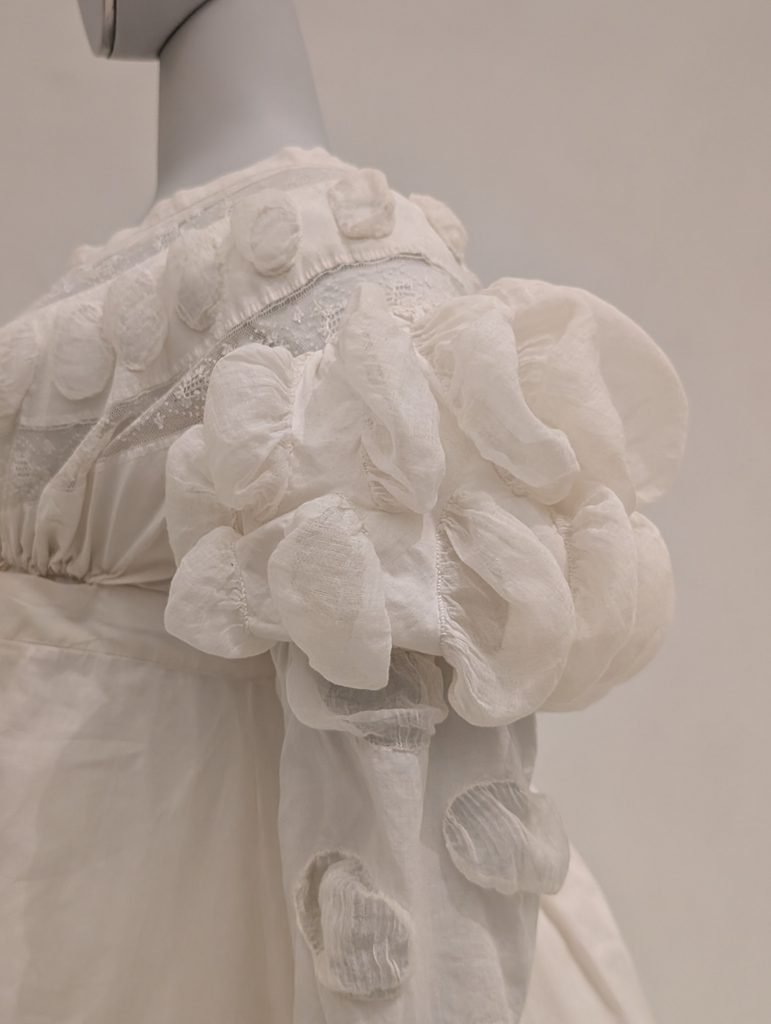
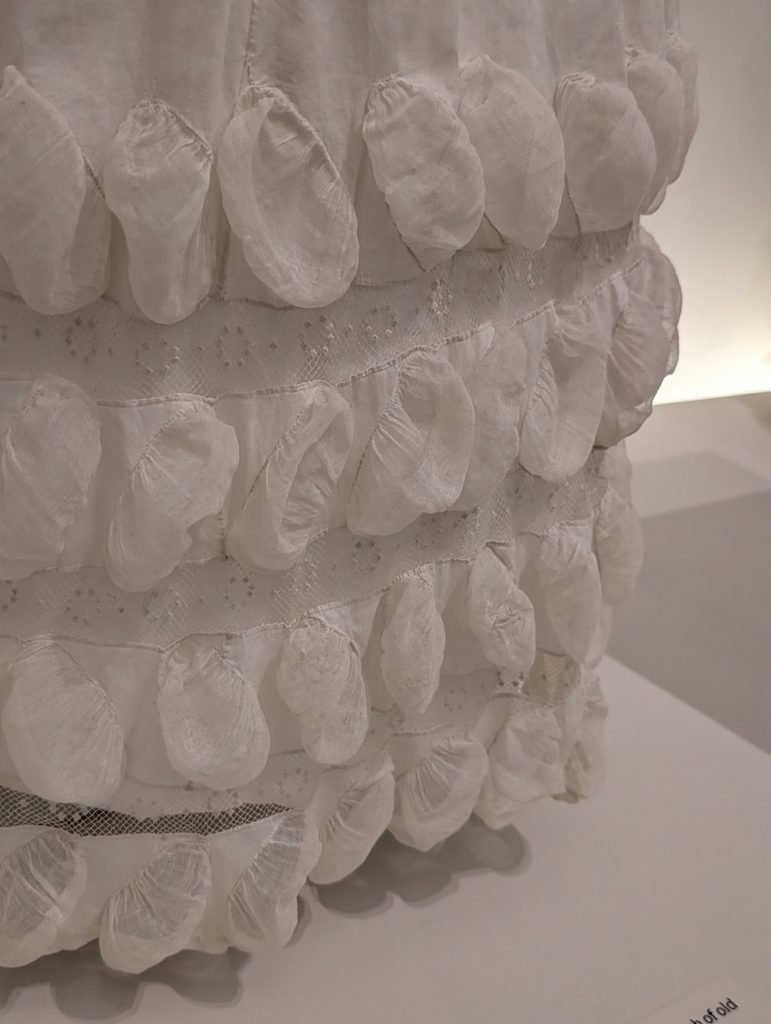
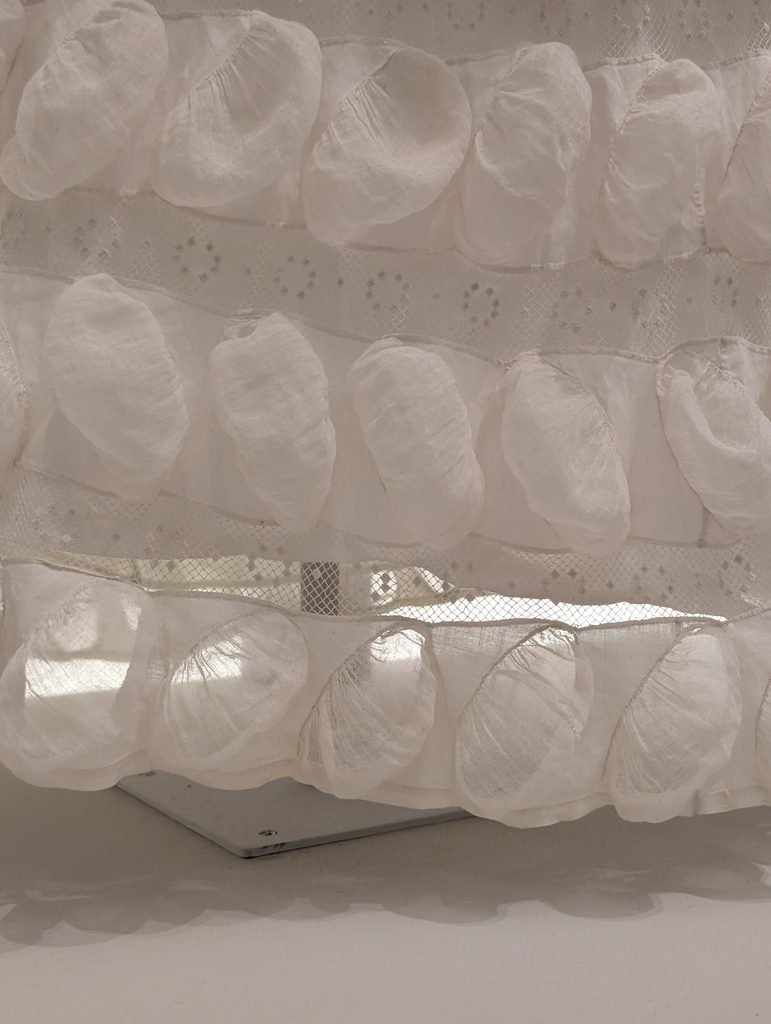
With this dress, the first thing that captures your attention is its extraordinary, sculptural trim. Large rounded details accent the shoulders, smaller ones cascade along the sleeves, and several voluminous rows line the bottom of the skirt, all fashioned from white fabric. From a distance, these elements resemble soft petals, while close-up views show how light passes through the sheer, delicate material. Between the rows of trim on the hem, delicate openwork inserts subtly peek through.
This European dress, dated to circa 1818, comes from the collection Costume Art exhibition at The Metropolitan Museum of Art in New York. According to the museum label, it is crafted from fine white cotton muslin.
Examining the Details Up Close
Just beneath the bust sits a neat, narrow waistband, from which the skirt falls in long, soft folds. On the back, the fabric is gathered much more densely than at the front, creating a lovely draped train. The bodice also features fine vertical gathers, while its upper section is framed by several bands of lace and textured trim.
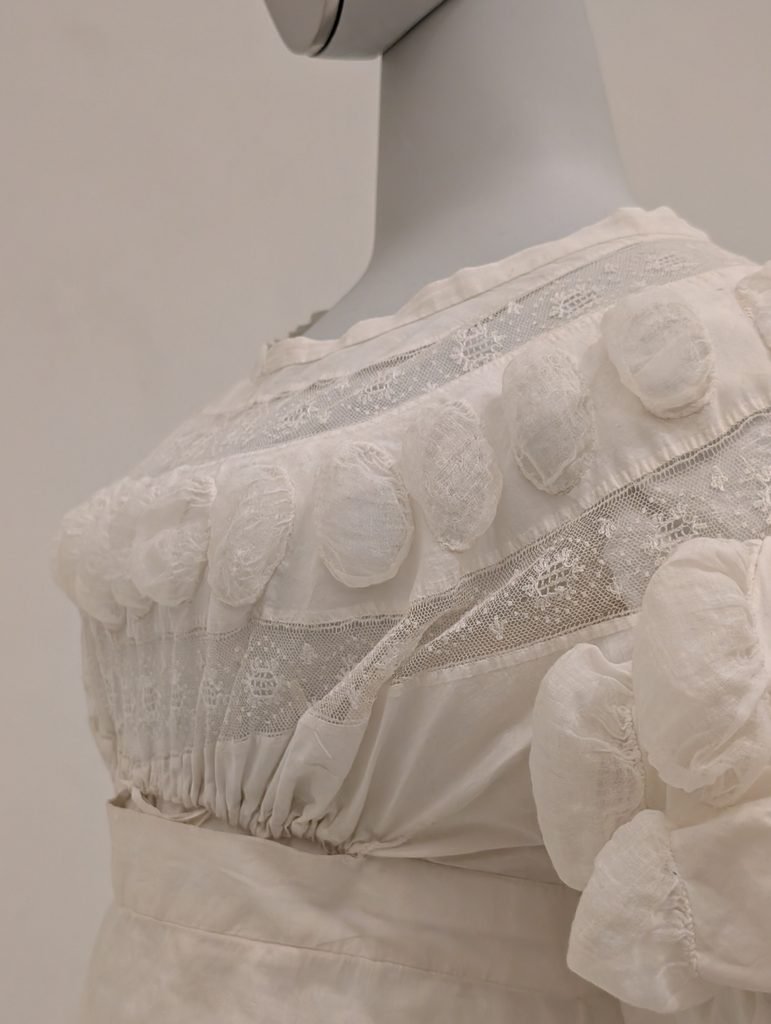
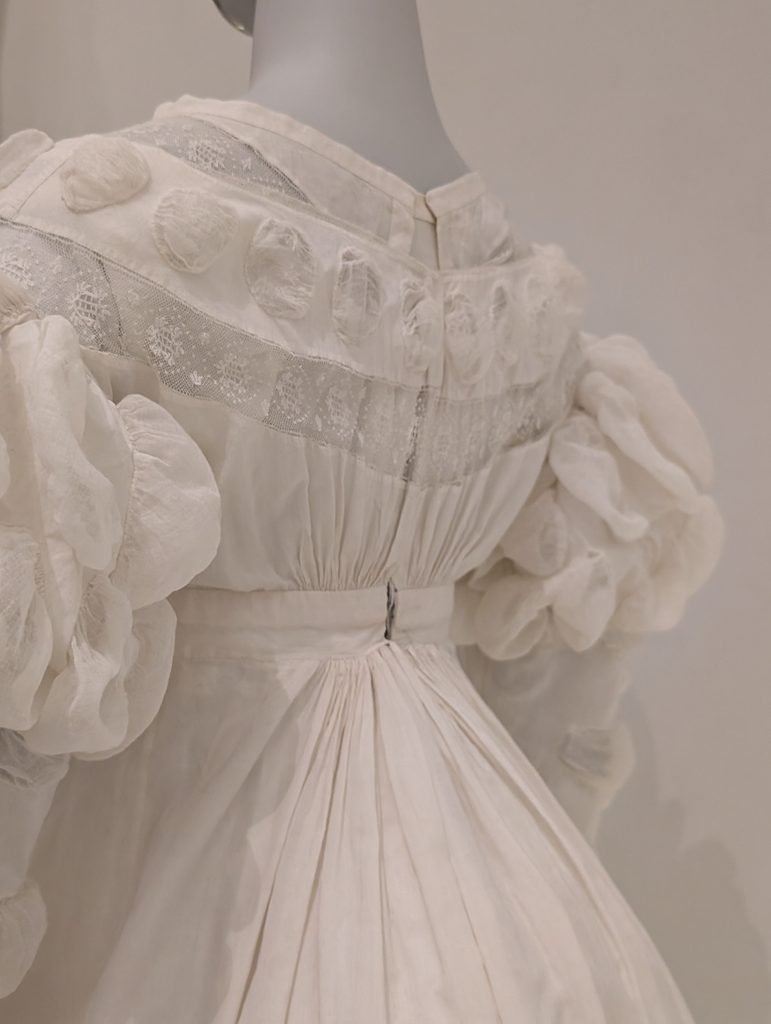
European, ca. 1818
White cotton muslin
Purchase, Marcia Sand Bequest, in memory of her daughter Tiger (Joan) Morse, 1981.
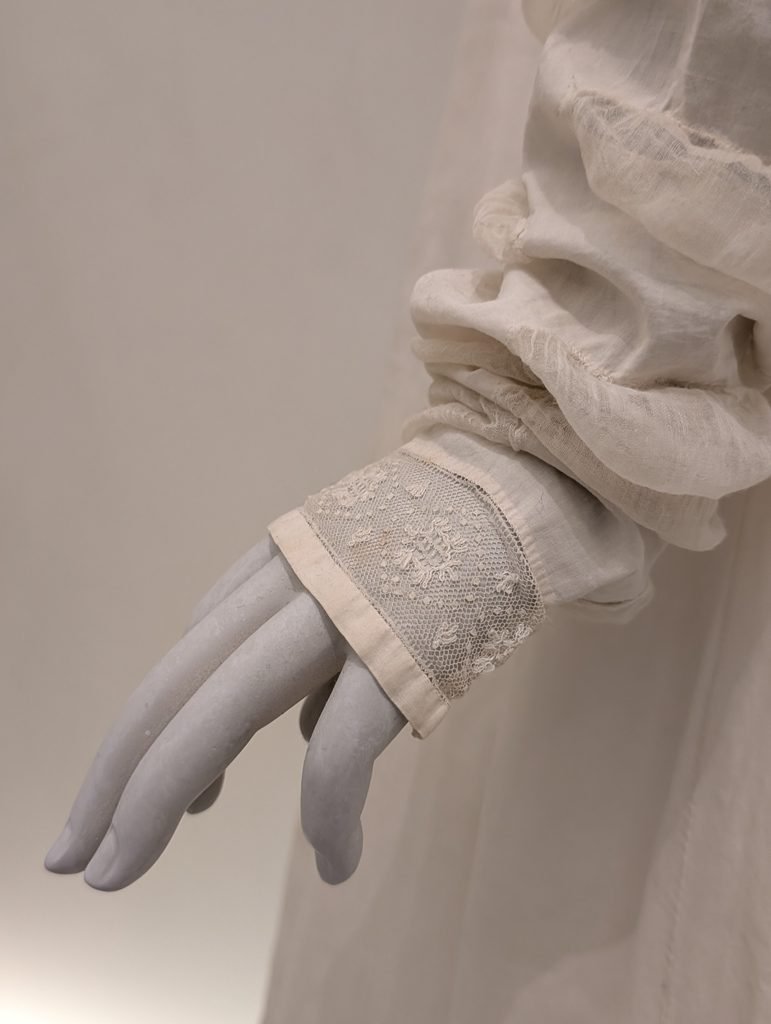
The shoulder line is particularly expressive and bold. Voluminous rounded elements form a cloud-like composition around the shoulders, while below, the sleeve narrows significantly and terminates in a delicate lace cuff. This contrast is beautifully visible from a side angle: playful fullness above, a slender sleeve line, and a soft finish at the wrist.
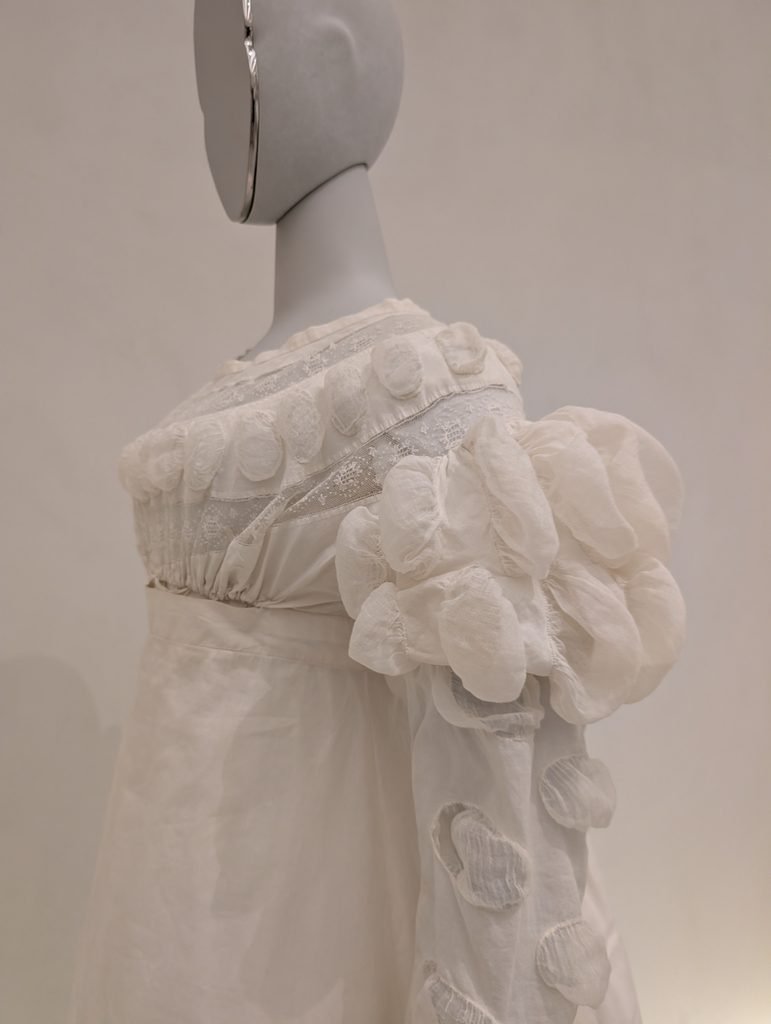
European, ca. 1818
White cotton muslin
Purchase, Marcia Sand Bequest, in memory of her daughter Tiger (Joan) Morse, 1981.
The hem of the skirt deserves a moment of admiration. Repeating tiers of dimensional “petals” give the lower skirt a rich visual weight. There is no color contrast here, the entire artistic effect relies on form, the interplay of light and shadow, and the transparency of the fabric between layers.
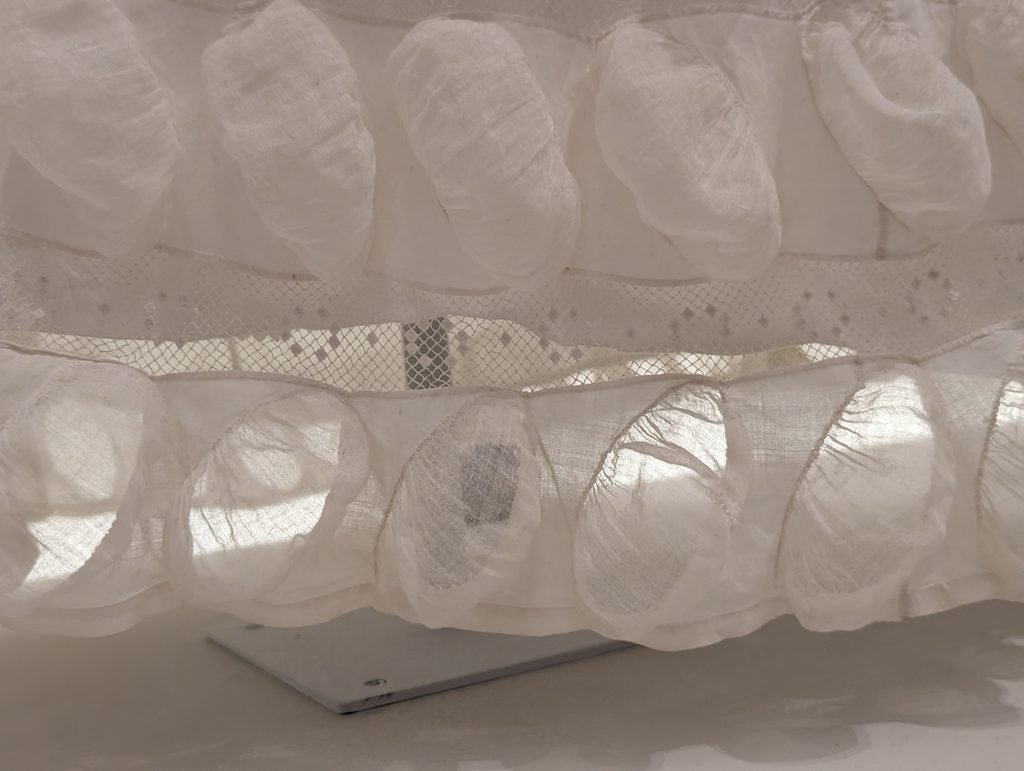
European, ca. 1818
White cotton muslin
Purchase, Marcia Sand Bequest, in memory of her daughter Tiger (Joan) Morse, 1981.
Shifting Trends in 1810s Fashion
As noted in the museum gallery text, throughout the 1810s, women’s dresses grew progressively shorter, their outlines became more angular and defined, and fullness increasingly concentrated at the rear.
To achieve this silhouette, women wore padded bustle pads or rolls under their skirts. These created a rear projection and gave the figure a rounded, slightly forward-inclined posture. Contemporaries referred to this look as “The Grecian Bend,” as it reminded them of the distinct postures seen on ancient Greek vases.
We previously encountered this phrase in our post on the 1870s dress and the 1868 satirical lithograph. But here we are looking at much earlier Regency/Empire fashion! Museum displays vividly show how the very same term re-emerged across different eras whenever a silhouette with pronounced rear volume became a hot topic of conversation and satirical humor.
That said, it is impossible to determine from the photographs alone what specific padding structure was used with this particular dress. The museum text outlines the broader trend of the decade rather than confirming the presence of a specific pad under this displayed garment.
When Old Fashion Meets New
Displayed alongside the muslin dress in the gallery is a hand-colored 1817 etching titled A Change in the Petticoats, or the Years 1780 & 1817. Its attribution goes to the British caricaturist William Heath, better known under the pseudonym “Paul Pry”.
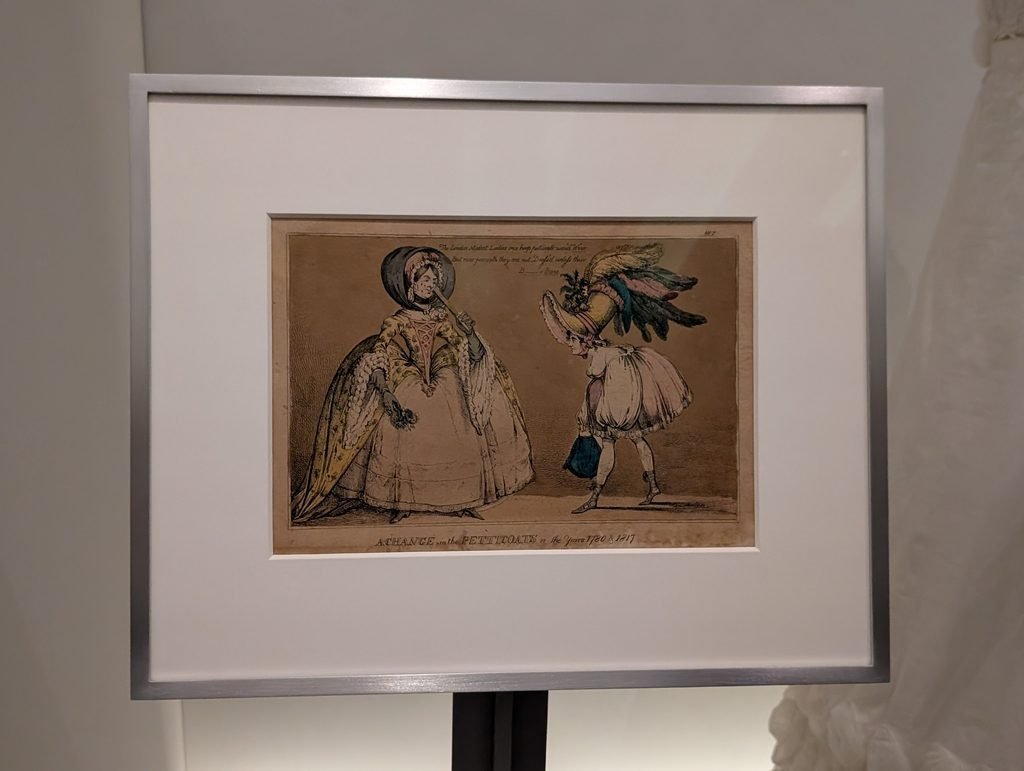
(British, 1794/95-1840)
A Change in the Petticoats, or the Years
1780 & 1817, 1817
Hand-colored etching
Gift of Jill Spalding, 2022.
The print brings together two fashionable women from drastically different eras. One represents 1780: tight corsetry, wide panniers, and a rigid, upright posture. The other is a young fashionable woman of 1817, wearing a shorter, lighter, and completely differently constructed dress.
According to the museum description, the elder woman looks with stern disapproval at the younger woman, whose forward-inclined posture exposes her neckline. The satirist intentionally sharpens this generational clash: what one sees as the height of modern elegance, the other views as improper and absurd.
It’s a story anyone can recognize, even without formal knowledge of fashion history. Eras and dresses change, but the timeless debate over “how young people dress nowadays” remains identical.
A Garment Is Not a Caricature
Viewing these two objects side by side is deeply rewarding. In satirical art, everything is exaggerated—the old fashion, the new fashion, and the dramatic poses of the characters. The authentic dress, however, allows us to shift our attention from satire to pure craftsmanship, to examine the featherlight muslin, delicate gathers, sculpted shoulders, and weightless drapes at the back.
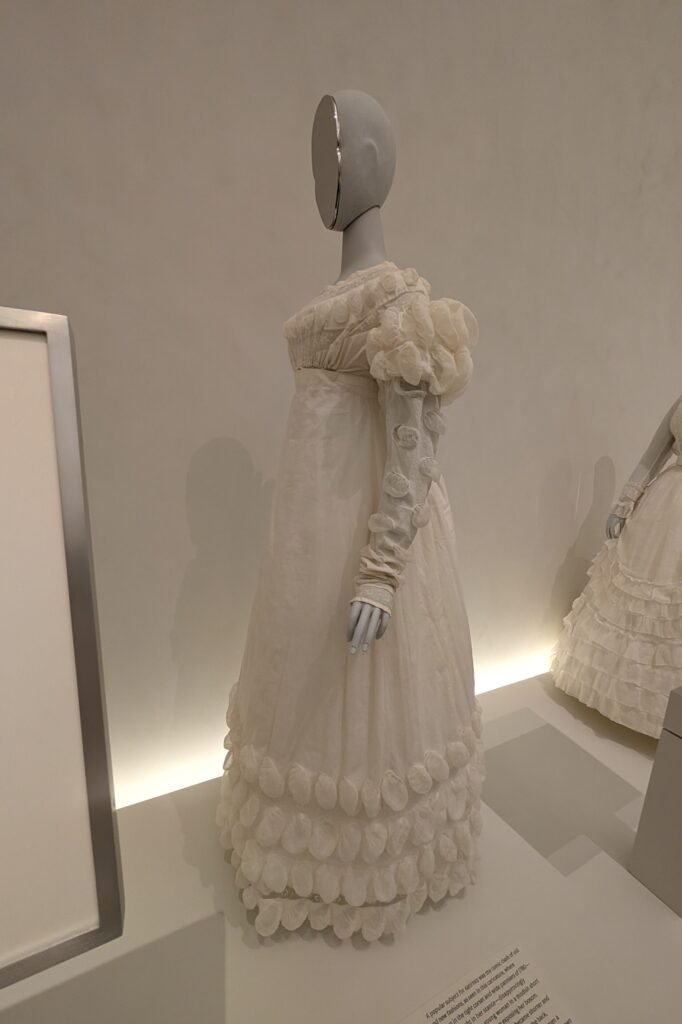
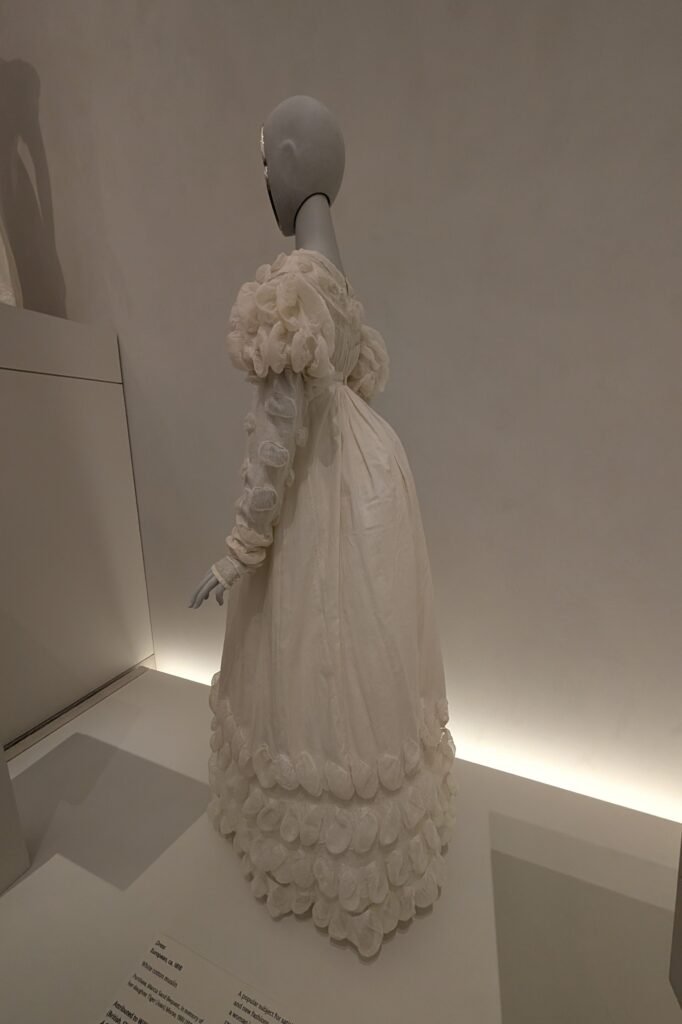
European, ca. 1818
White cotton muslin
Purchase, Marcia Sand Bequest, in memory of her daughter Tiger (Joan) Morse, 1981.
The caricature tells us what contemporaries laughed at, while the physical dress reveals the true beauty of the fashion without satirical hyperbole.
What I Look at as a Doll Clothes Artisan
For a doll clothing maker, this dress is a masterclass in working with monochromatic white volume. Creating these “petals” while preserving their translucent quality in miniature scale is delicate, rewarding work.
- Fabric Selection: Standard muslin will be far too stiff in doll scale. A fine silk lawn, batiste, or featherlight silk organza would be the ideal choice.
- Shoulder Construction: To recreate those rounded, petal-like sleeve accents without bulking up a doll’s shoulder joint, precise micro-hemming and delicate pressing are crucial.
- Hem Transparency: To recreate the delicate openwork between the tiers of “petals,” ultra-fine Valenciennes cotton lace or delicate net lace will add the perfect level of intricate texture to a miniature skirt.
Object Details
- Dress (Day Dress):
- Date: ca. 1818
- Culture: European
- Medium: White cotton muslin
- Credit Line: Purchase, Bequest of Marcia Sand, in memory of her daughter Tiger (Joan) Morse, 1981
- Accession Number: 1981.13.3
- Print (A Change in the Petticoats, or the Years 1780 & 1817):
- Date: 1817
- Artist: William Heath (“Paul Pry”, 1794/95–1840)
- Medium: Hand-colored etching
- Credit Line: Gift of Jill Spalding, 2022
- Accession Number: 2022.309.14
- Department & Exhibition: The Costume Institute, Costume Art Exhibition, The Metropolitan Museum of Art, New York
Sources & Further Reading
- Dress (ca. 1818) — The Metropolitan Museum of Art, Accession Number: 1981.13.3.
- A Change in the Petticoats, or the Years 1780 & 1817 (1817) — William Heath (“Paul Pry”), The Metropolitan Museum of Art, Accession Number: 2022.309.14.
- Costume Art — Exhibition materials & gallery label texts, The Costume Institute, The Metropolitan Museum of Art, New York.
- Regency Fashion and Satire — History of early 19th-century cotton muslin, decorative trim, and Regency bustle roll padding.