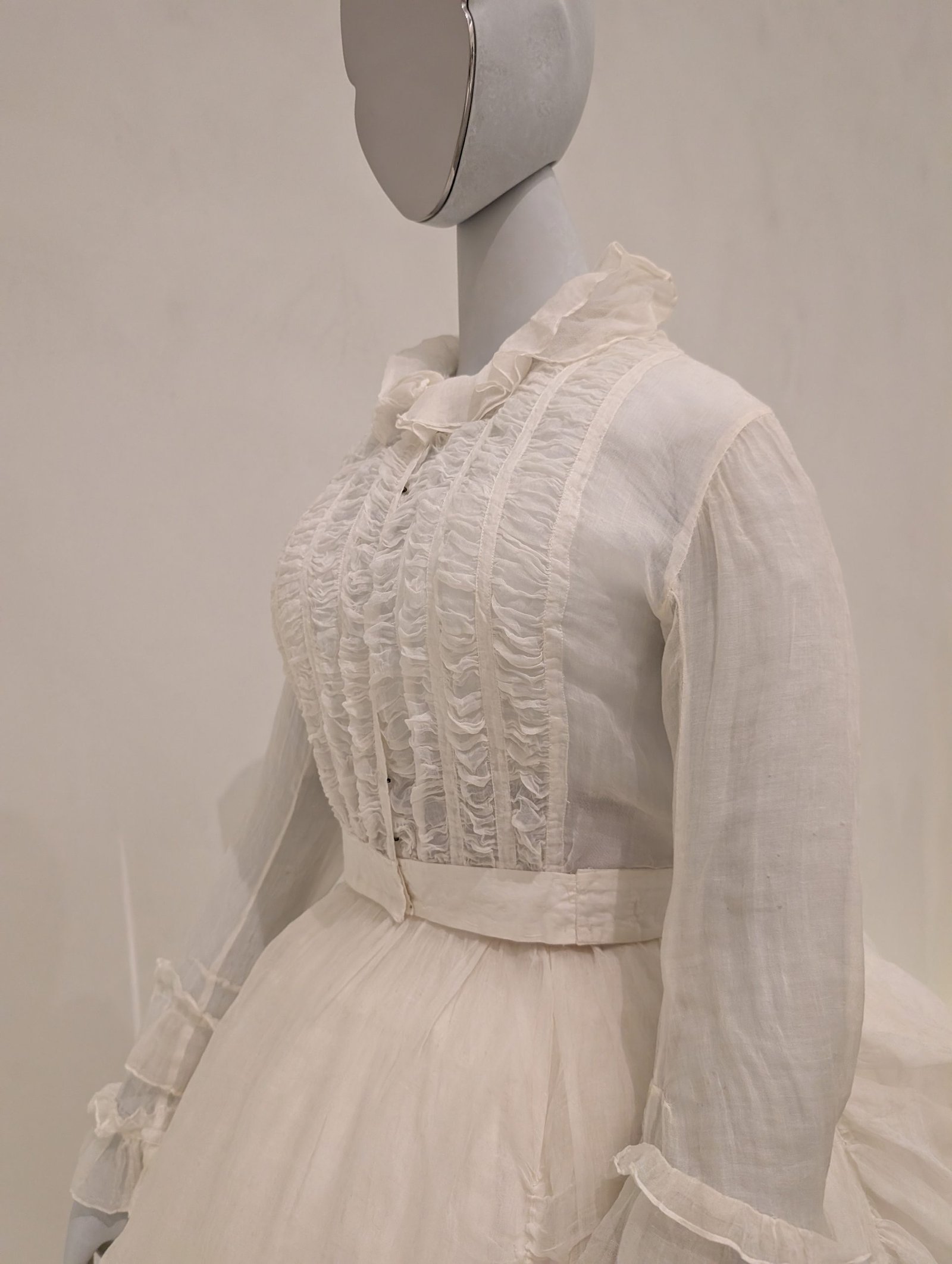

Following our look at the beige dress with mauve ribbons, let’s examine another remarkable piece from the Costume Art exhibition at The Metropolitan Museum of Art in New York. This time, we turn to an American dress from the 1870s, crafted entirely from crisp white cotton organdy.
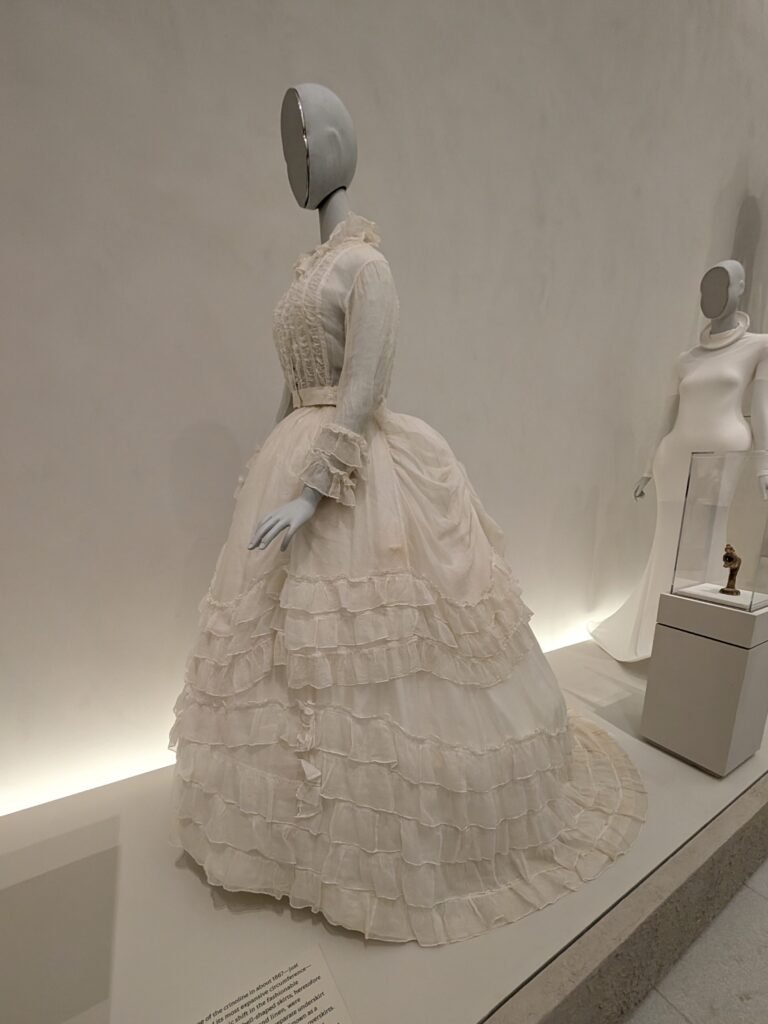
Here, we encounter a completely different design approach. There are no contrasting colorful ribbons or rich velvet motifs drawing the eye. Everything is monochrome white, and it is precisely this purity of tone that invites us to look closer: at the delicate ruffles on the bodice, the neatly trimmed collar, the layered cuffs, and the sweeping tiers of the skirt. Sunlight and soft gallery spotlights play across the translucent fabric, bringing every subtle fold and shadow to life.
Examining the Details Up Close
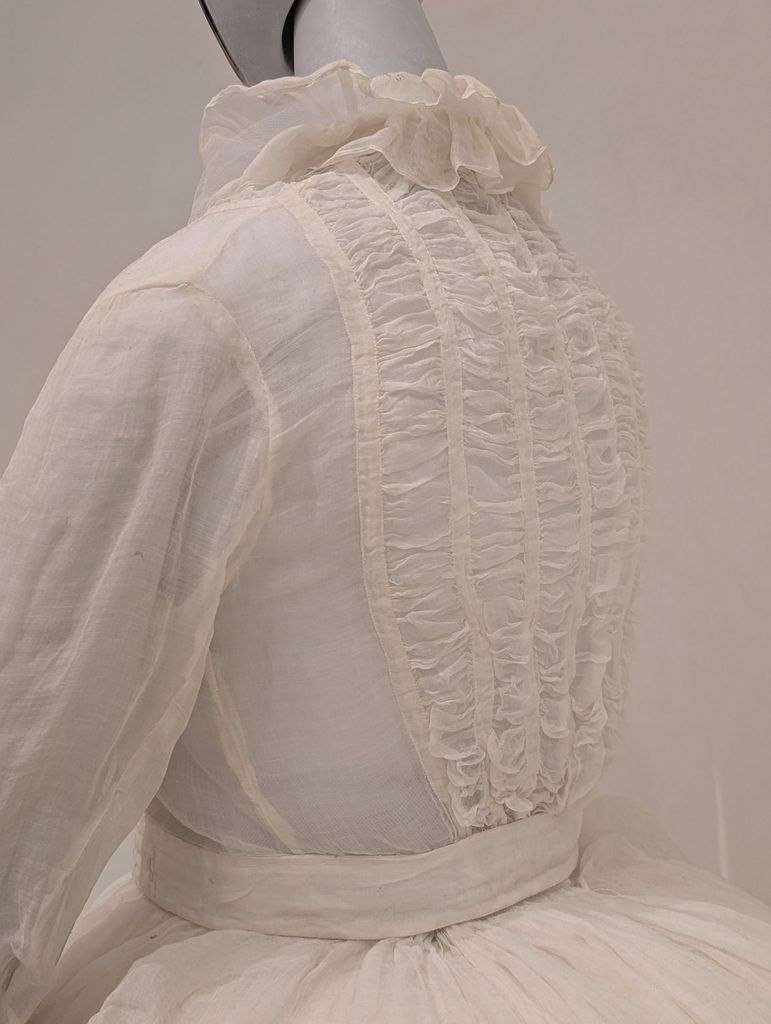
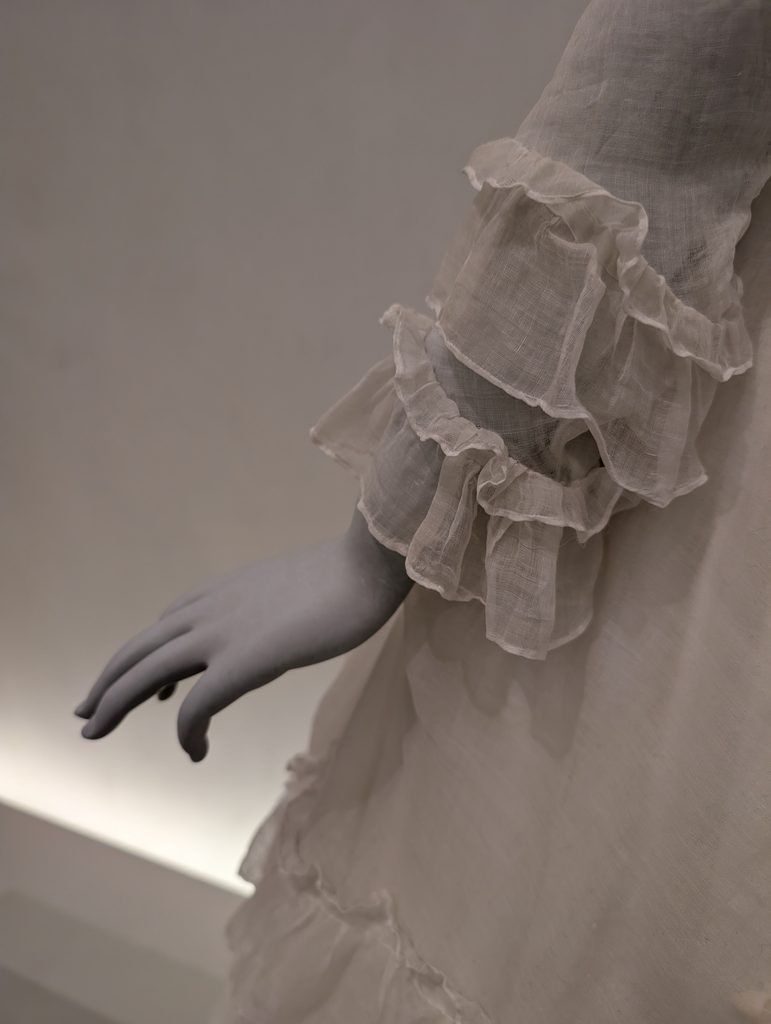
The bodice features a high, neat collar trimmed with a fine ruffle, complemented by dense vertical rows of gathered trim down the front. A wide waistband of the same organdy defines the waistline. Long, narrow sleeves end in multi-tiered ruffled cuffs, a detail that looks exceptionally airy and delicate in close-up views.
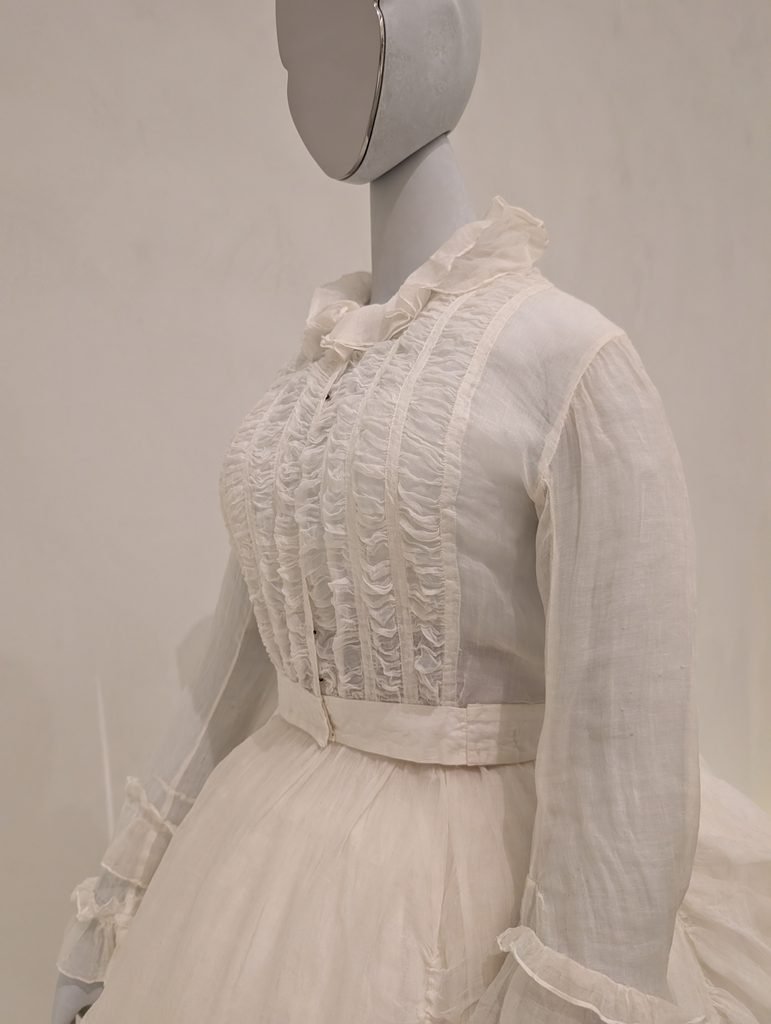
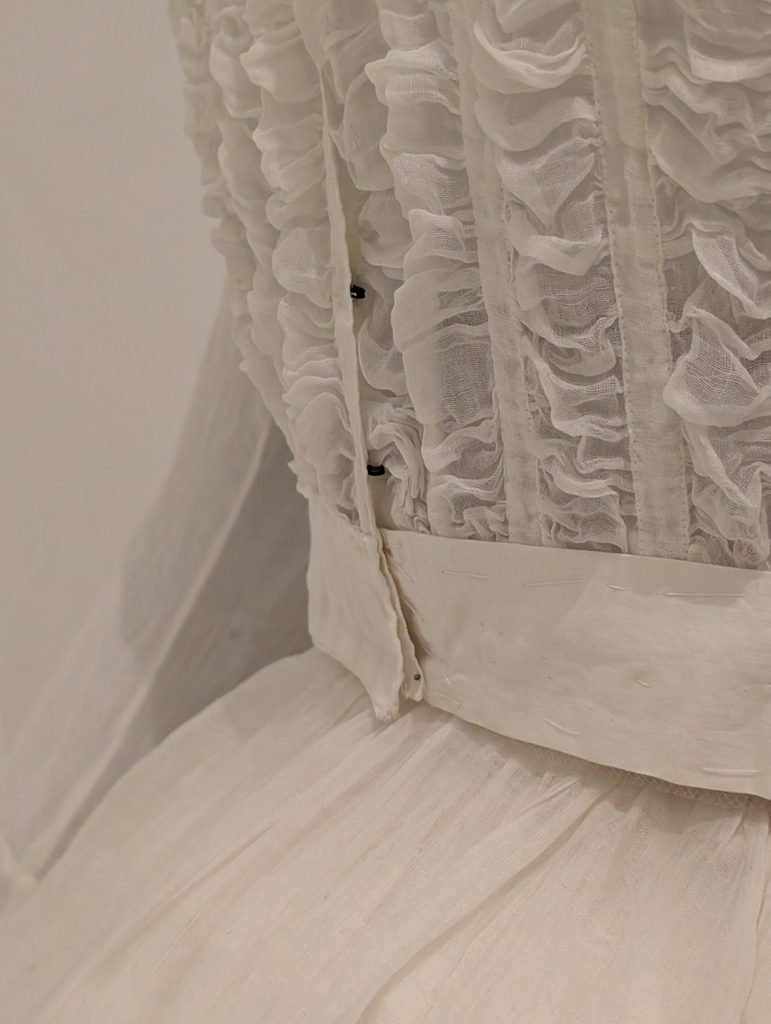
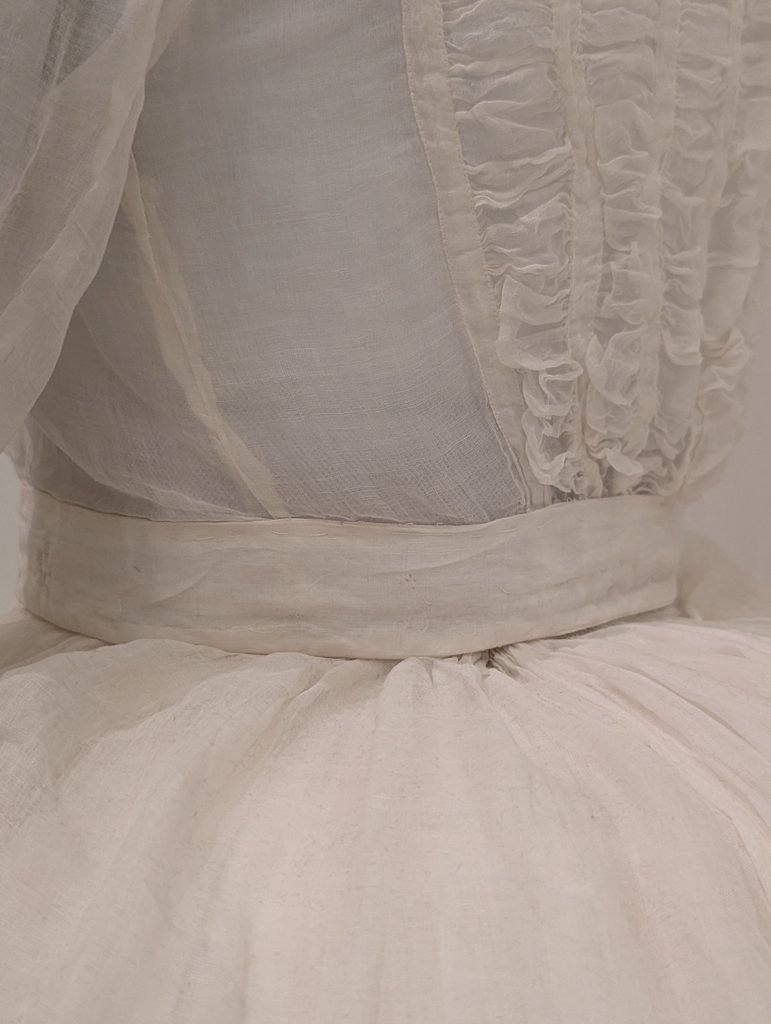
American, 1870s
White cotton organdy
Gift of Richard Martin, 1993.
The skirt is equally embellished with horizontal rows of ruffles. From a distance, they blend into a light, cloud-like white surface, but up close, the rich, tactile texture reveals itself.
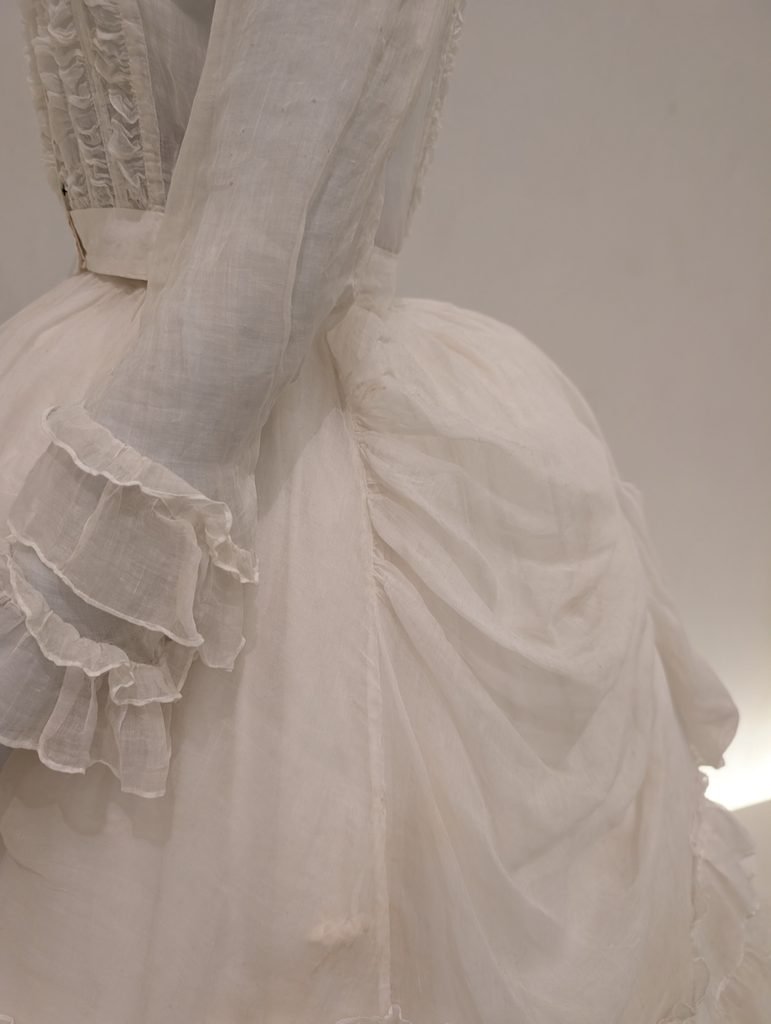
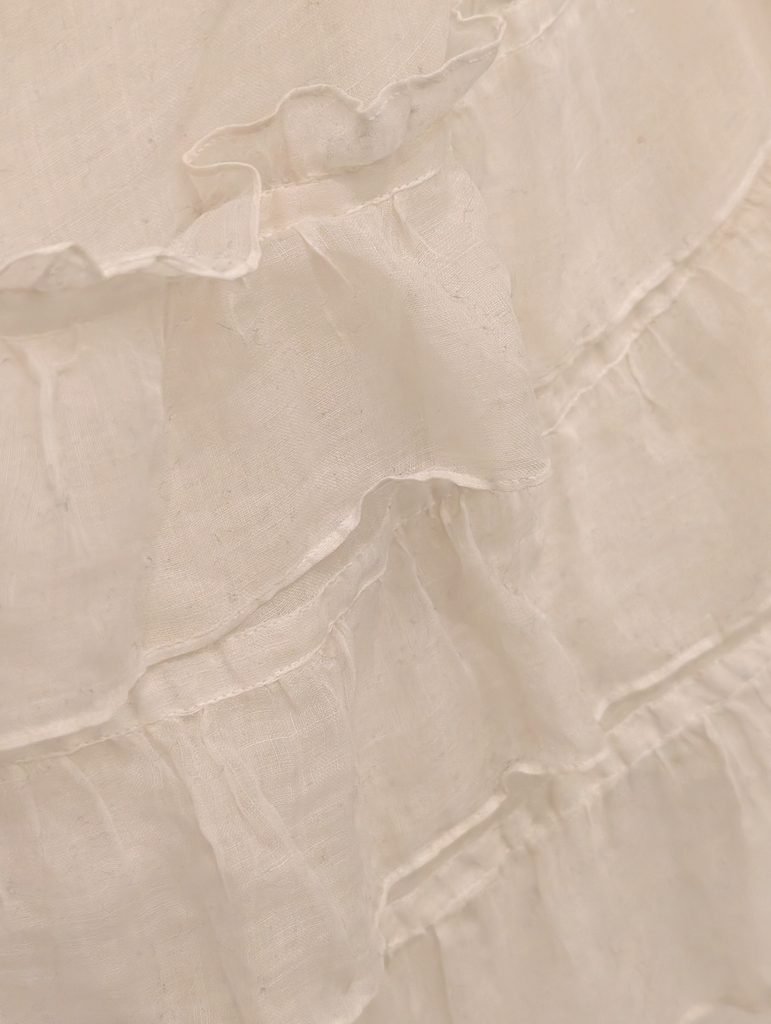
American, 1870s
White cotton organdy
Gift of Richard Martin, 1993.
From a profile view, you can clearly see how the fabric is gathered and lifted at the back. This backward distribution of volume marks a decisive departure from the symmetrical, dome-shaped crinolines of the previous decade.
Where Did the Dome Crinoline Go?
As noted in the museum gallery commentary, around 1867, shortly after the grand dome crinoline reached its peak, the fashionable silhouette underwent a dramatic shift. Fullness didn’t disappear; rather, its center of gravity moved decisively to the rear.
Over-skirts were looped, draped, and pulled up at the back, exposing the underskirt beneath. This style was often referred to as a polonaise, referencing 18th-century fashion revivals.
To support this new shape, the structural foundation changed too. Massive circular hoop skirts gave way to crinolettes, half-hoop cages with a pronounced rear projection that served as direct precursors to the full bustle.
In this dress, the play of volume is fascinating: the front remains relatively flat and restrained, while the organdy at the back forms a voluminous, weightless cascade.
A Satirical Neighbor: “The Grecian Bend”
Displayed alongside this delicate gown is a hand-colored 1868 lithograph titled The Grecian Bend: Fifth Avenue Style. The museum label credits the famous printmaking firm Currier & Ives and artist Thomas B. Worth.
This isn’t an idealized fashion illustration, but a humorous commentary on contemporary trends. Around 1868, the exaggerated rear silhouette became a favorite target for caricaturists. Artists mocked the forward-leaning posture, dubbed “the Grecian bend”, that women were supposedly forced to adopt while balancing such garments.
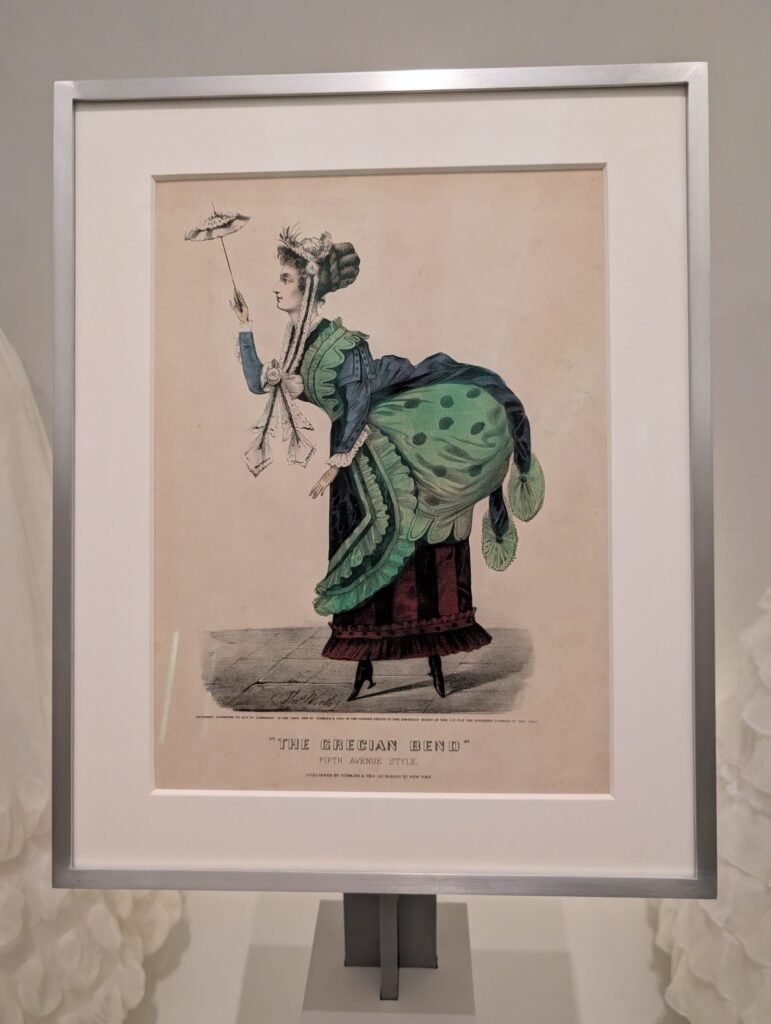
The Grecian Bend: Fifth Avenue Style, 1868
Hand-colored lithograph
Gift of Andrew Bolton, 2026.
While satirical prints always exaggerate for comedic effect, placing it next to an authentic gown highlights just how striking and controversial this fashion shift was to contemporaries.
What I Look at as a Doll Clothes Maker
For a doll clothing artisan, white organdy is both an inspiration and a creative challenge. Without color contrast, craftsmanship, neat tucks, and precise ruffling take center stage.
In miniature scale, recreating a dress like this calls for exceptionally fine, sheer fabrics, such as silk voile, silk organza, or ultra-light cotton lawn. My key considerations when adapting this piece would be:
- Scaling the ruffles proportionally: Keeping every tier micro-sized and neatly pressed so as not to bulk up the miniature bodice.
- Structuring the bustle drape: Gathering the sheer fabric at the back so that it retains its crisp, vaulted shape without collapsing under its own weight.
- Highlighting transparency: Recreating those delicate, layered sheer cuffs on translucent sleeves to achieve that authentic museum-quality refinement.
Object Details
- Garment: Day Dress
- Date: 1870s
- Culture: American
- Medium: White cotton organdy
- Credit Line: Gift of Richard Martin, 1993
- Accession Number: 1993.35.1a–c
- Print: The Grecian Bend: Fifth Avenue Style
- Date: 1868
- Artist / Publisher: Currier & Ives (drawn by Thomas B. Worth)
- Medium: Hand-colored lithograph
- Credit Line: Gift of Andrew Bolton, 2026
- Accession Number: 2026.37
- Department & Exhibition: The Costume Institute, Costume Art Exhibition, The Metropolitan Museum of Art, New York
Sources & Further Reading
- Dress (1870s) — The Metropolitan Museum of Art, Accession Number: 1993.35.1a–c.
- The Grecian Bend: Fifth Avenue Style (1868) — Currier & Ives (drawn by Thomas B. Worth), The Metropolitan Museum of Art, Accession Number: 2026.37.
- Costume Art — Exhibition materials & gallery labels, The Costume Institute, The Metropolitan Museum of Art, New York.
- Victorian Fashion and Satire — History of early bustle transition and crinolette silhouettes in 1860s–1870s American fashion.