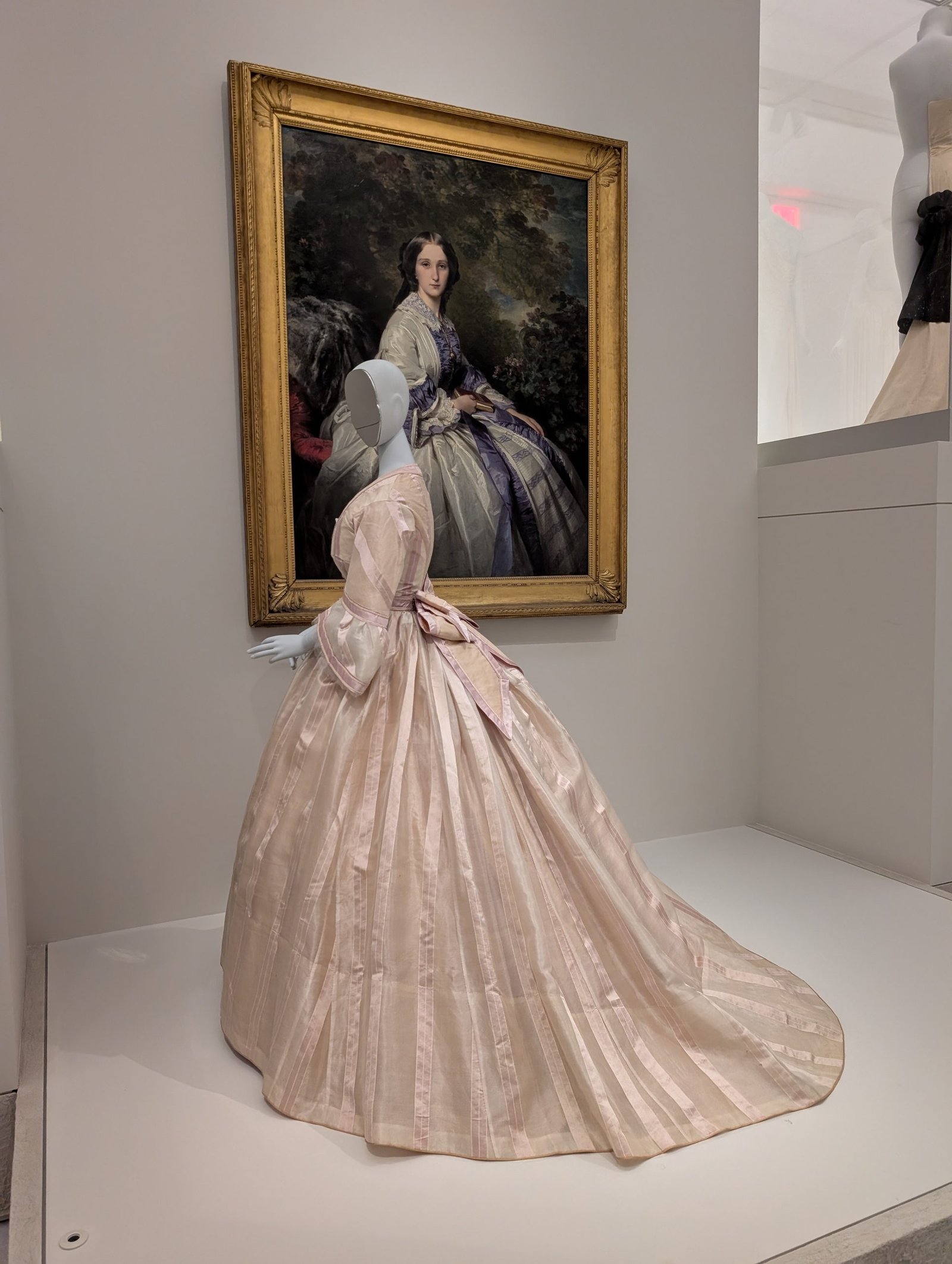

Delicate beige organza, the muted lilac sheen of satin ribbons, and a full skirt, this day dress combines the lightness of fabric with an expressive architectural silhouette. In The Metropolitan Museum of Art (MET) catalog, it is dated to approximately 1865 and identified as French. It entered The Costume Institute collection in 1969 as a gift of Mary Pierrepont Beckwith.
Fabric, Color, and Trim
According to the museum description, the bodice and skirt are crafted from beige silk organza and trimmed with appliquéd ribbons made of mauve silk satin. The waistband is made of beige silk taffeta.
The photographs of the garment clearly demonstrate how the ribbons structure its surface:
- Geometry and Lines: They outline the square neckline, highlight the structural seam lines of the bodice, frame the wide bell sleeves, and extend vertically down the skirt.
- Sleeve and Neckline Details: Close-up views reveal delicate trim along the neckline and soft lace under-sleeves, adding an extra layer of refinement.
- Buttons: The front closure of the bodice is detailed with decorative fabric-covered buttons.
- Back Accent: On the back, the trim forms a prominent, large bow with long, wide tails, a bold focal point set against the deep folds of the skirt.
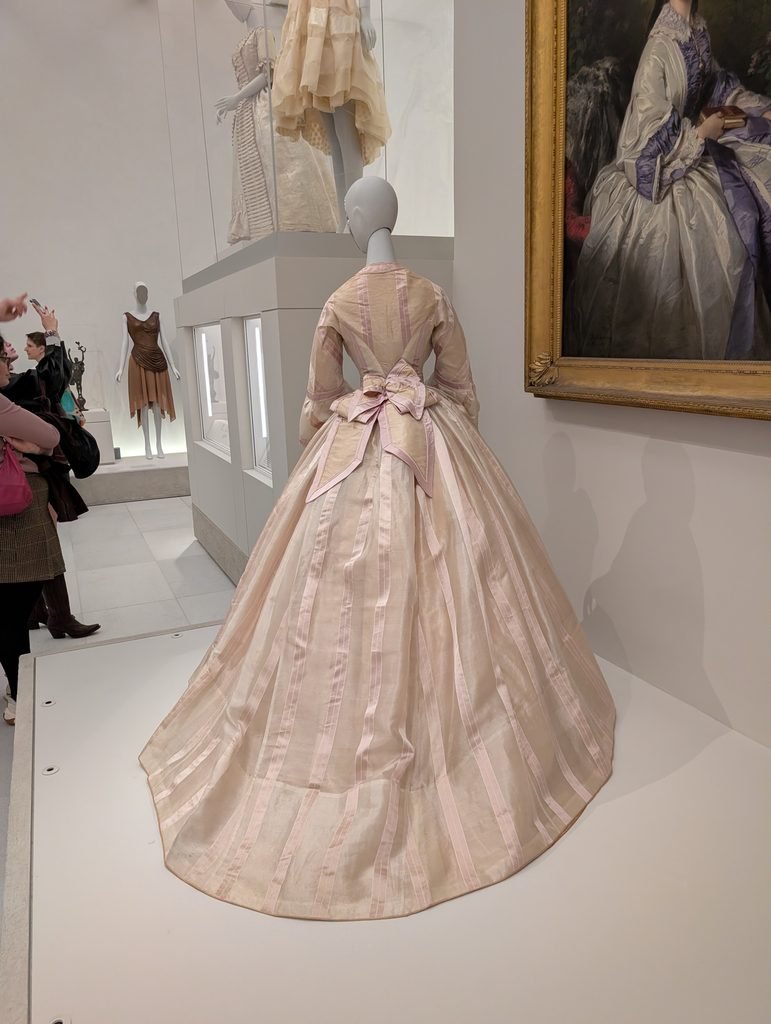
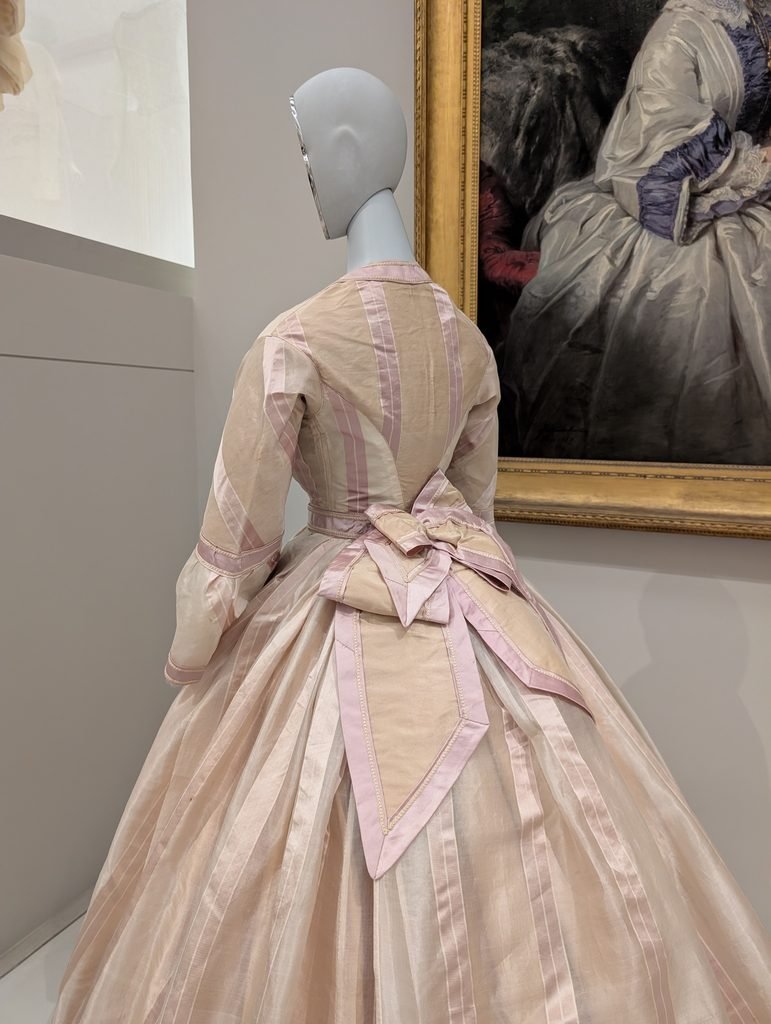
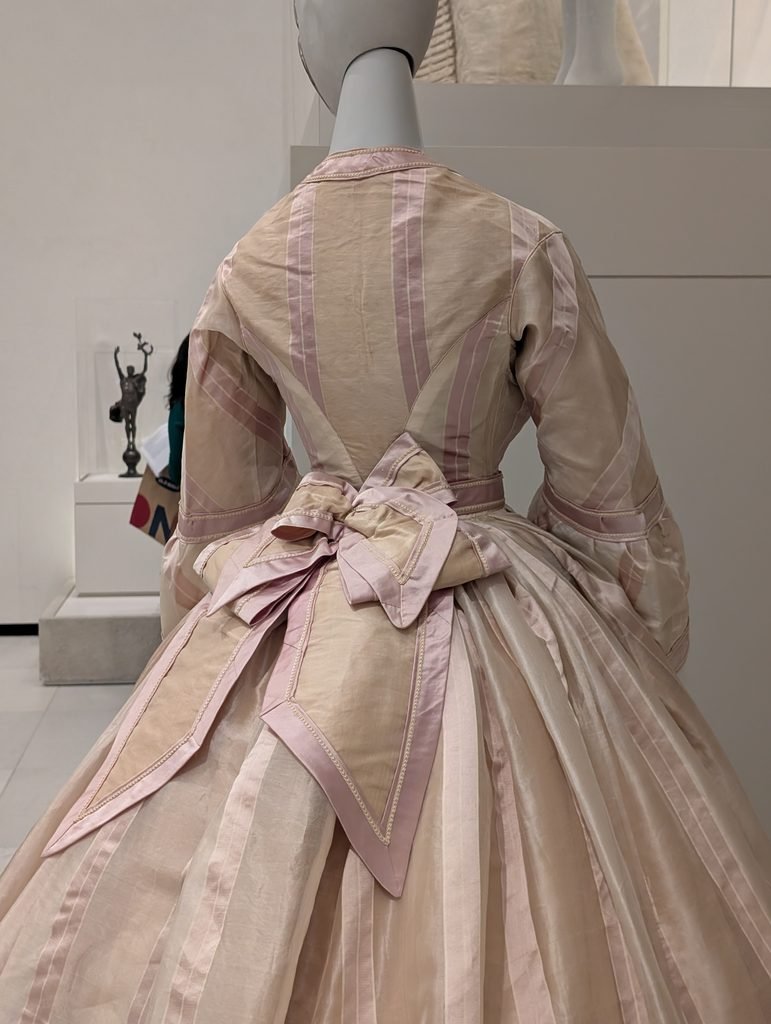
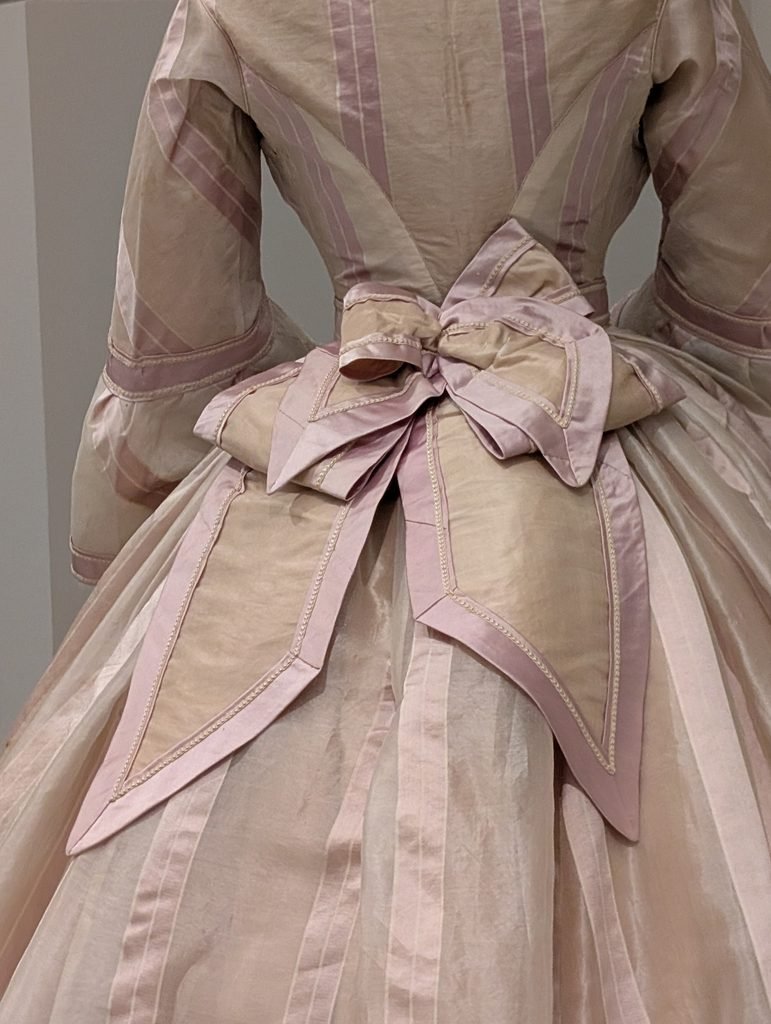
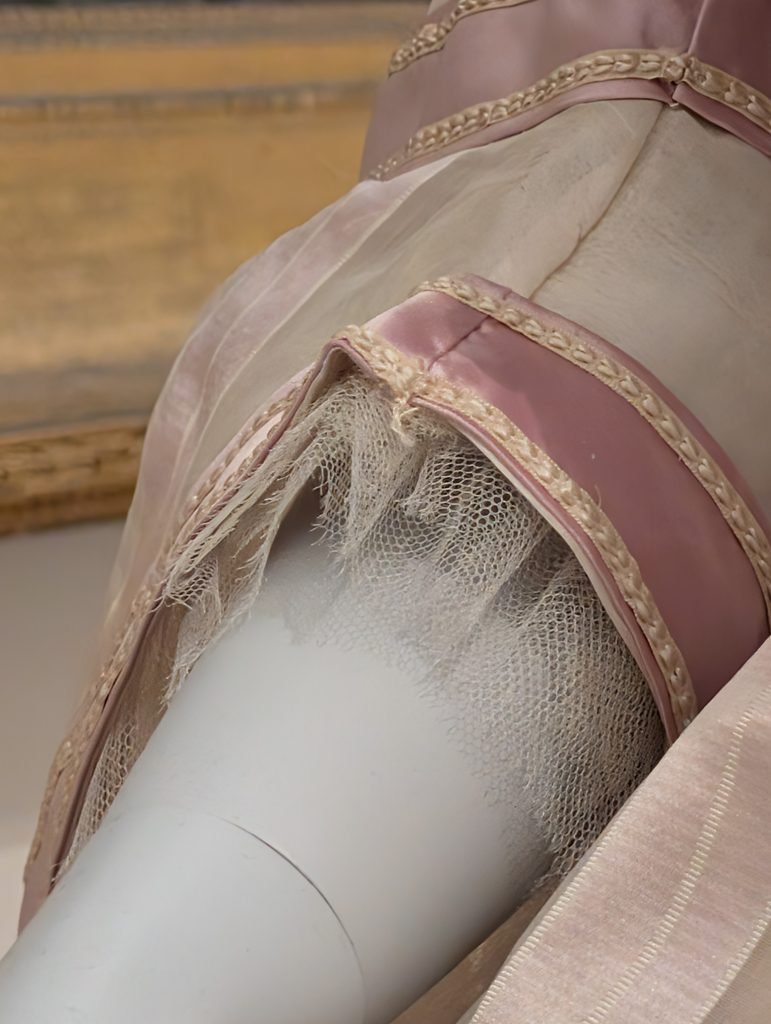
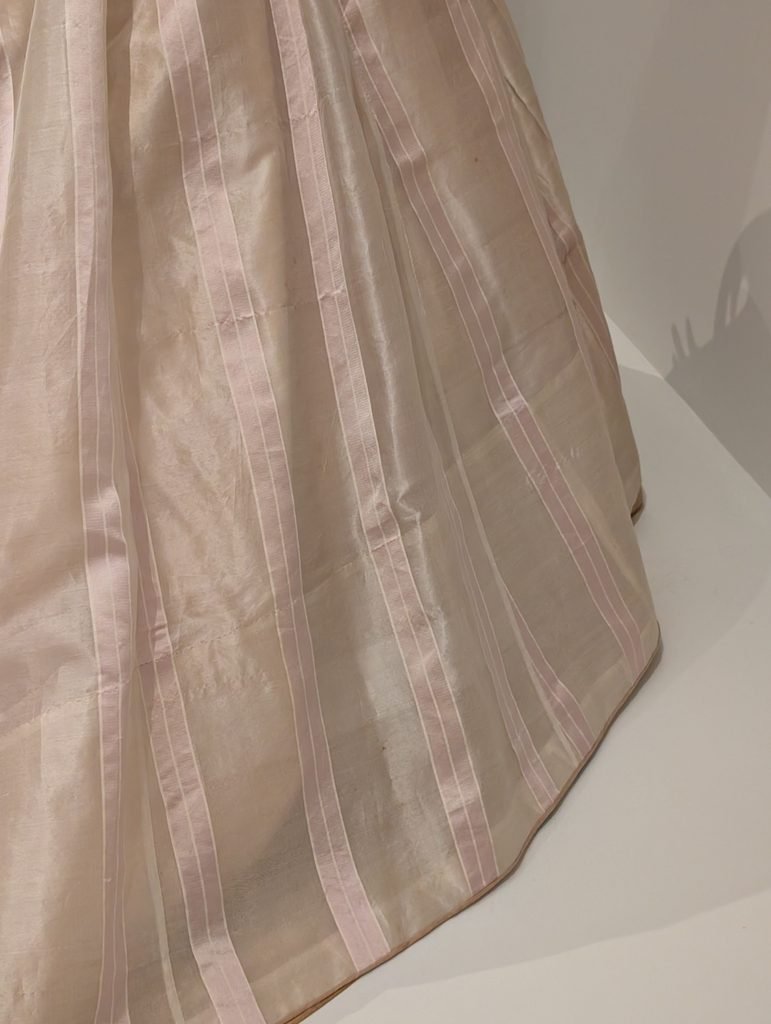
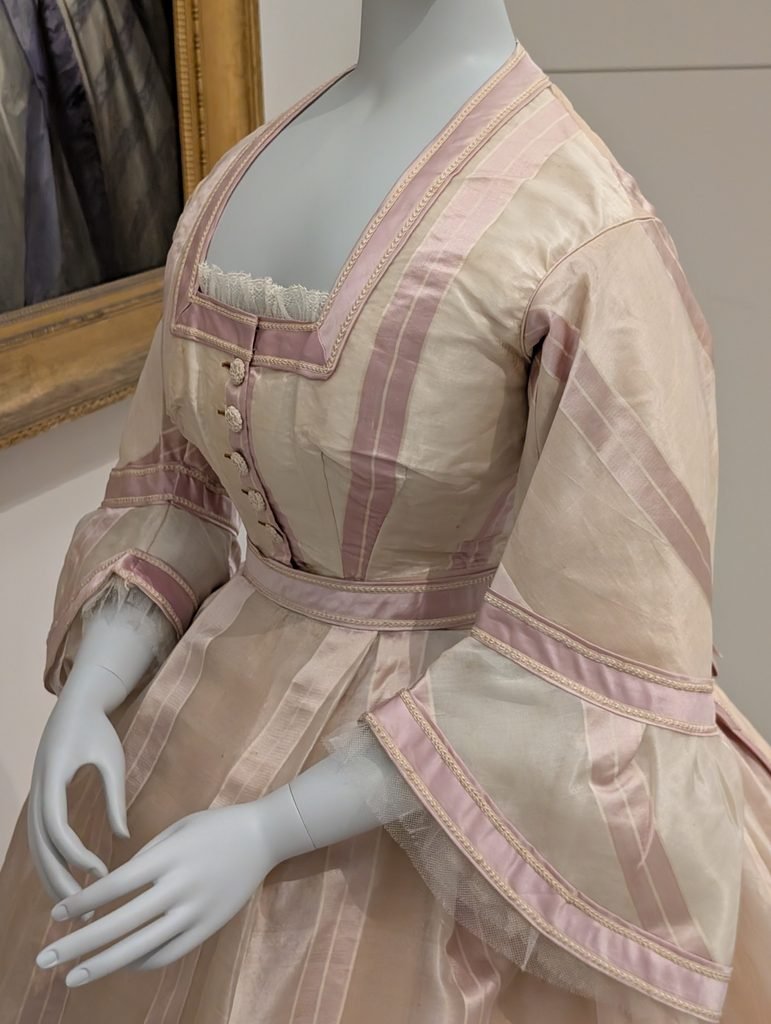
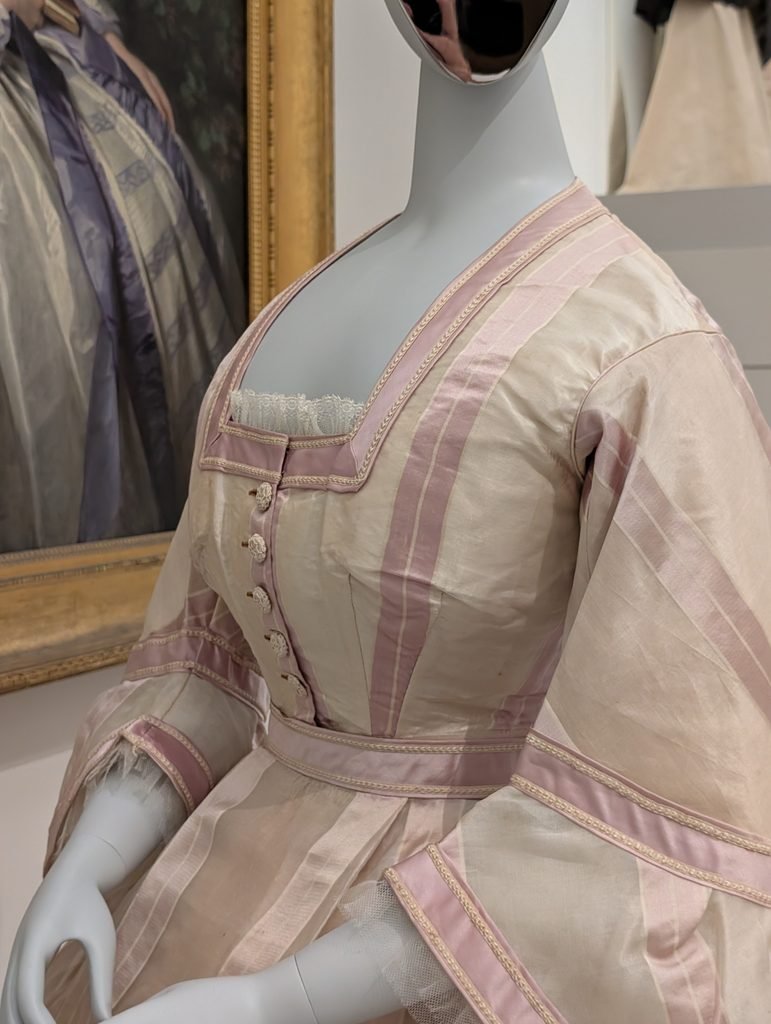
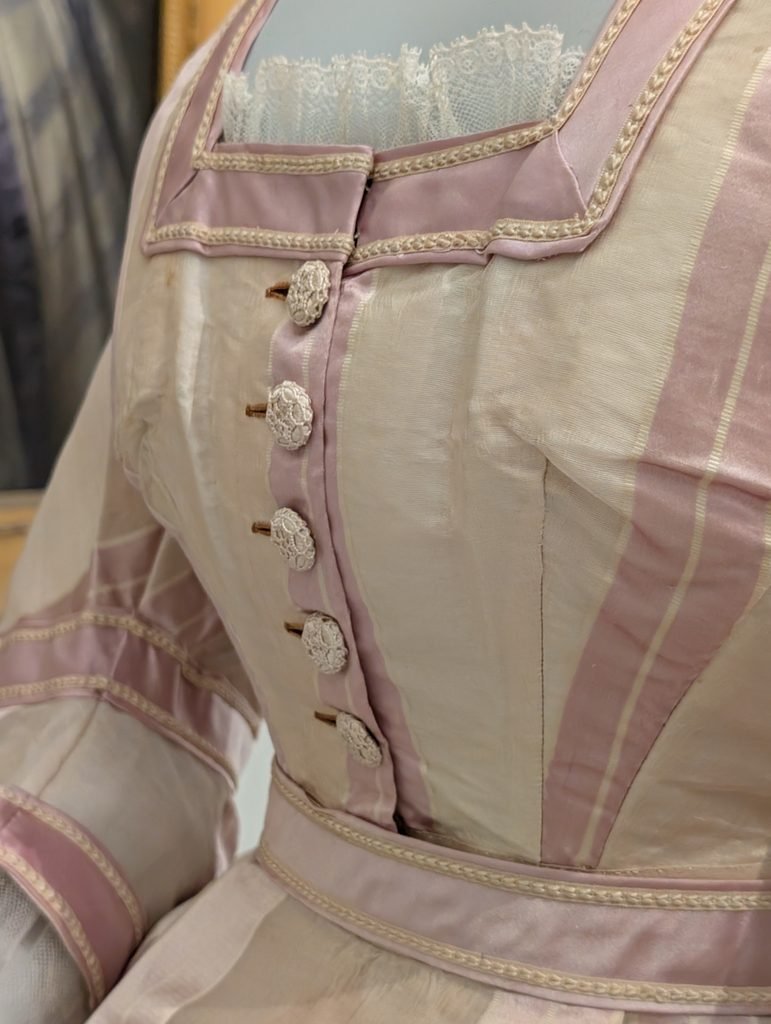
Bodice and skirt of beige silk organza appliquéd with mauve silk satin ribbon; belt of beige silk taffeta
Gift of Mary Pierrepont Beckwith, 1969.
The overall impression relies on a contrast of textures: sheer, lightweight organza and smooth satin reflect light differently. As a result, even a subtle beige and mauve palette appears rich, ensuring the ribbons do not get lost among the volumetric folds.
The Evolution of the Voluminous Silhouette
The museum text connects the shape of this dress to the long evolution of structured skirts:
- 18th-Century Panniers: Expanded the silhouette primarily at the sides and remained in fashion until the 1780s.
- 1830s Revival: Broad volume returned in the form of dome-shaped skirts supported by multiple petticoats — often corded, ruffled, or heavily starched.
- The 1856 Crinoline: Steel hoop cages replaced cumbersome layers of fabric. This flexible structure enabled expansive, vaulted skirts without the immense weight of numerous petticoats.
By the 1860s, this voluminous silhouette reached the height of its popularity. In this dress, the effect is enhanced by the organza itself: airy yet crisp enough to hold defined folds. The satin ribbons emphasize the sweep of the skirt, turning its shape into the main decorative motif.
The Dress alongside Winterhalter’s Portrait
In the gallery display, the dress is paired with a portrait of Countess Lamsdorff, Maria Ivanovna Beck (1835–1866), wife of Alexander Nikolaevich Lamsdorff. Franz Xaver Winterhalter (1805–1873) painted this oil on canvas portrait in 1859.
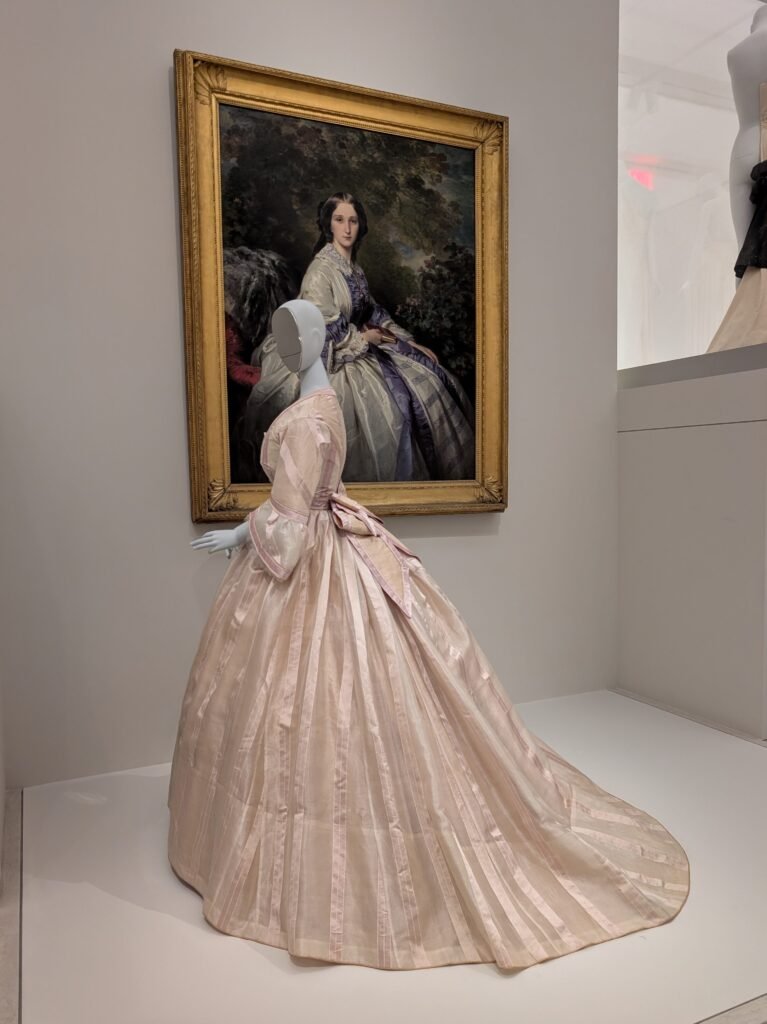
Countess Alexander Nikolaevitch
Lamsdorff (Maria Ivanovna Beck, 1835-1866), 1859
Oil on canvas
Bequest of Miss Adelaide Milton de Groot (1876-1967), 1967.
This side-by-side presentation bridges surviving physical fashion with the painted ideals of the era:
- It highlights the grand, romanticized court silhouettes characteristic of Winterhalter’s portraiture.
- The physical dress offers a tactile perspective on the painterly image, showcasing how fabric weight, trim placement, and structural volume were translated on canvas through light and color.
- This pairing is thematic: there is no record indicating that the dress belonged to the sitter in the painting.
What I Look at as a Doll Clothes Maker
For me as a maker, the most captivating element of this ensemble is how the ribbons function as a structural framework. Rather than merely decorating the surface, they “anchor” the sheer organza, establishing a clear rhythm and vertical flow.
In doll-scale tailoring, pairing a fine beige silk gauze or organza with narrow silk satin ribbons can recreate this exact sense of weightlessness. The key is choosing proportional ribbon widths to keep from overwhelming a miniature bodice while preserving the delicate lines of the square neckline and bell sleeves.
Object Details
- Title: Day dress
- Date: ca. 1865
- Culture: French
- Medium: Beige silk organza, mauve silk satin ribbon, beige silk taffeta
- Credit Line: Gift of Mary Pierrepont Beckwith, 1969
Sources & Further Reading
- Day Dress (ca. 1865) — The Metropolitan Museum of Art, Accession Number: C.I.69.33.11a–f.
- Portrait of Countess Lamsdorff (1859) — Franz Xaver Winterhalter, The Metropolitan Museum of Art, Accession Number: 2010.126.
- The Costume Institute — Exhibition label and object catalog documentation, The Metropolitan Museum of Art, New York.
- Corsets and Crinolines — Norah Waugh, Routledge / Theatre Arts Books, 1954 (for reference on the structural evolution of 19th-century hooped petticoats).