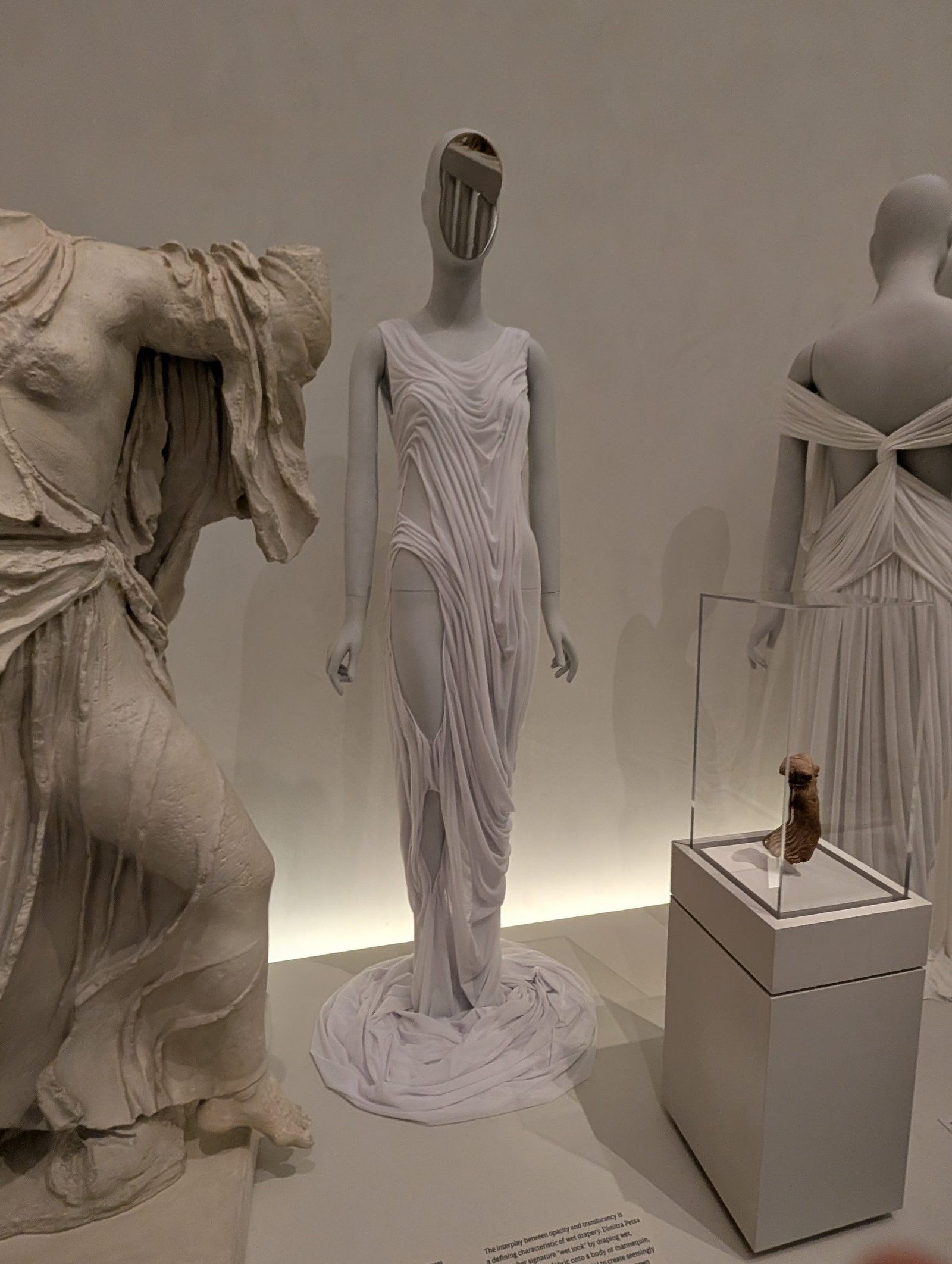

Classical sculpture has shaped fashion for centuries, from softly draped gowns to bodices molded like armor. The Classical Body section of Costume Art at The Metropolitan Museum of Art brings these connections into focus, pairing historical and contemporary designs with ancient works of art.
The Classical Body: When Fashion Becomes Sculpture
In this section, fashion transforms the body into an ancient statue, wraps it in “wet” drapery, or encases it in a rigid, armor-like shell. From a distance, it might look like a collection of Greek-inspired dresses. But for those of us who make clothes, the details tell another story: how cut, folds, and materials shape an “ideal” body, and how designers keep rethinking that ideal.
Where the Ideal Began
The classical concept of the body was born in Antiquity. In the 5th century BCE, the sculptor Polykleitos formulated a mathematical blueprint for the perfect figure in his treatise, the Canon, a system he called symmetria, where every proportion harmonized with the next. From this emerged contrapposto: shifting the body’s weight onto one leg. It created an impression of relaxed, perfectly balanced, and calculated poise.
Later, Praxiteles softened these rigid rules, infusing his sculptures with sensuality, fluid grace, and gentle curves.
The entire exhibition balances precisely between these two poles: the body as mathematical proportion and the body as living sensuality. For a maker, it is extraordinary to observe how sculptural modeling translates directly into structural cut and line.
When a Dress Becomes Aphrodite
The Eupheme dress by Dolce & Gabbana (Alta Moda, Autumn–Winter 2019–2020) is entirely encrusted with embroidery, sequins, beads, and crystals. Yet this lavish embellishment serves a precise structural purpose: against sheer chiffon, the shimmering elements outline the silhouette of a nude female torso,or rather, a classical statue of Aphrodite.
While the wearer remains fully covered, the garment offers an idealized, marble-like illusion of nudity.
In this piece, the Pygmalion myth turns inside out: instead of a statue coming to life, a living woman transforms into a glowing goddess. It stands as a brilliant example of how fine jewelry embroidery can literally paint light, shadow, and contour across fabric.
Printed Muscles and the Body as Illusion
In Glenn Martens’s ensemble for Y/Project, anatomy becomes the primary optical focus: a nude male torso is printed directly across the jacket and trousers, veiled beneath a delicate layer of tulle. This is a direct nod to Polykleitos’s Diadumenos, an athlete whose relaxed contrapposto renders every muscle vital and deliberate.
Similarly, a 1999 Jean Paul Gaultier dress transfers a graphic rendering of the Louvre’s Venus of Arles onto fabric, turning the wearer into a marble goddess who is simultaneously fully clothed and seemingly exposed.
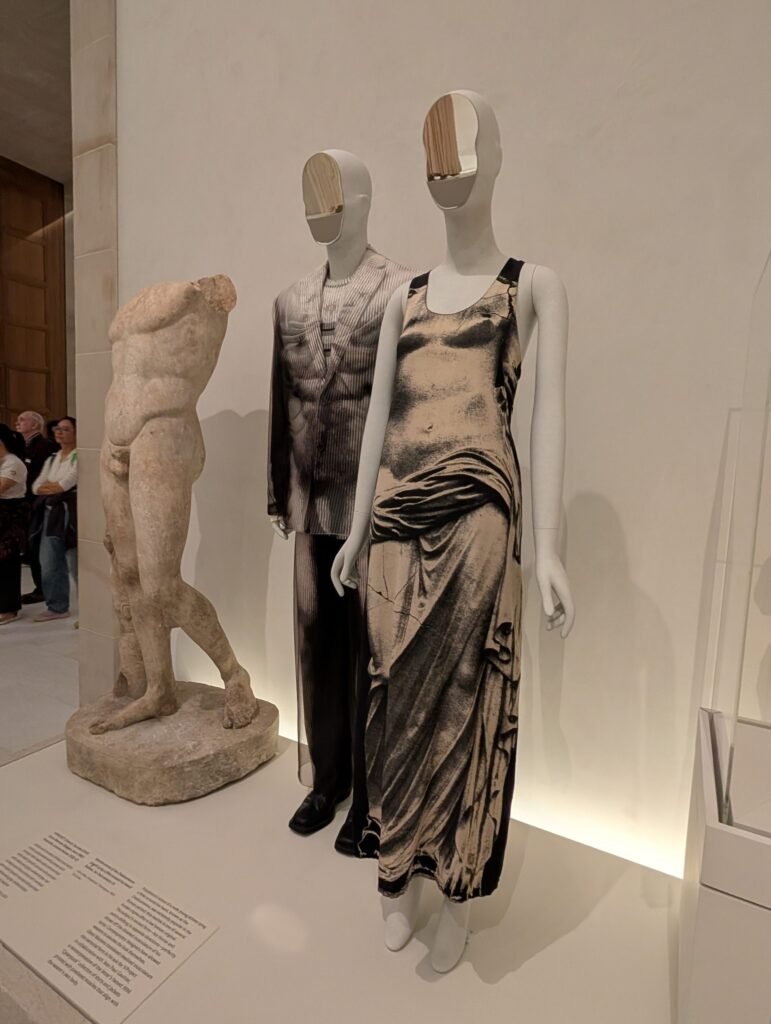
Copy of work attributed to Polykleitos
1st–2nd century CE
Ensemble
Design House Y/Project French
Designer Glenn Martens Belgian
fall/winter 2022–23
Dress
Designer Jean Paul Gaultier French
Design House Gaultier Paris French
spring/summer 1999
This two-dimensional print creates a striking sculptural illusion, but only until the wearer moves. The slightest step shatters the “marble” stillness, reminding us that we are looking at a living form, not stone.
“Wet” Drapery: Fabric That Conceals Nothing
One of the most captivating ideas from antiquity is “wet” drapery. In ancient Greek sculpture, folds wrapped the figure without hiding it: fabric appeared to cling to the chest, abdomen, and legs, tracing every subtle curve.
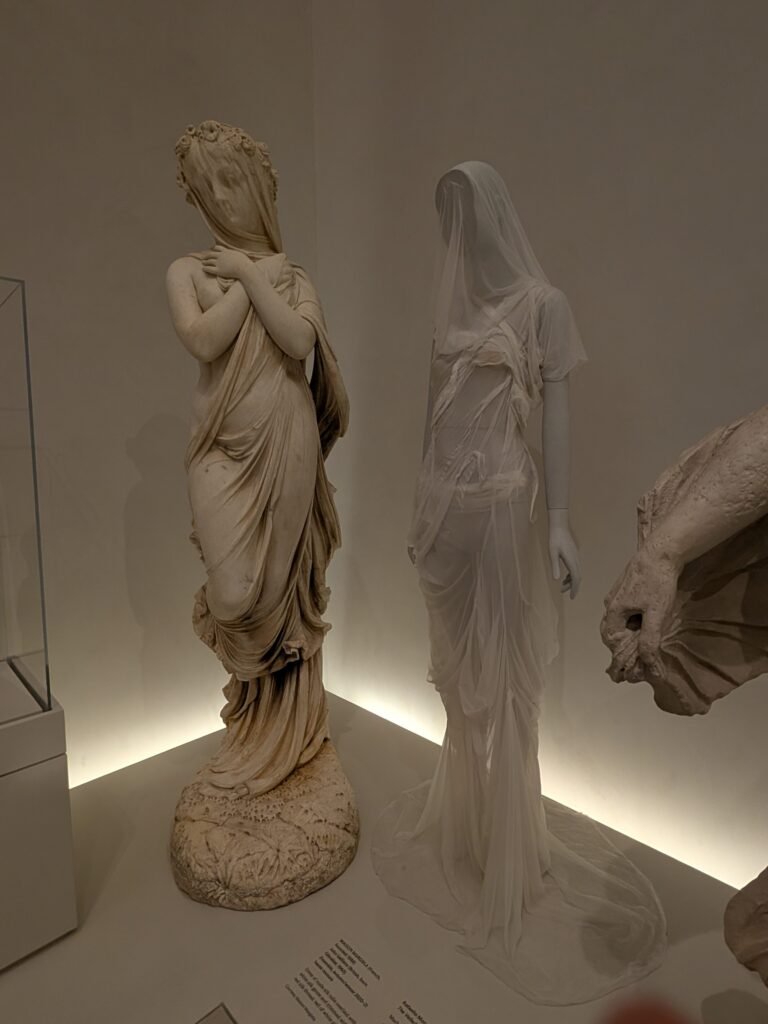
Rafaello Monti
1854
Ensemble
Design House Maison Margiela French
Designer John Galliano British
fall/winter 2020–21 haute couture
In the 19th century, Raffaello Monti carved his Veiled Lady from marble, forcing hard stone to look like an weightless, translucent veil. John Galliano for Maison Margiela does the inverse: using fine layers of silk and tulle, he lends soft textiles a monumental, stone-like presence. Monti turns stone into cloth; Galliano turns cloth into stone.
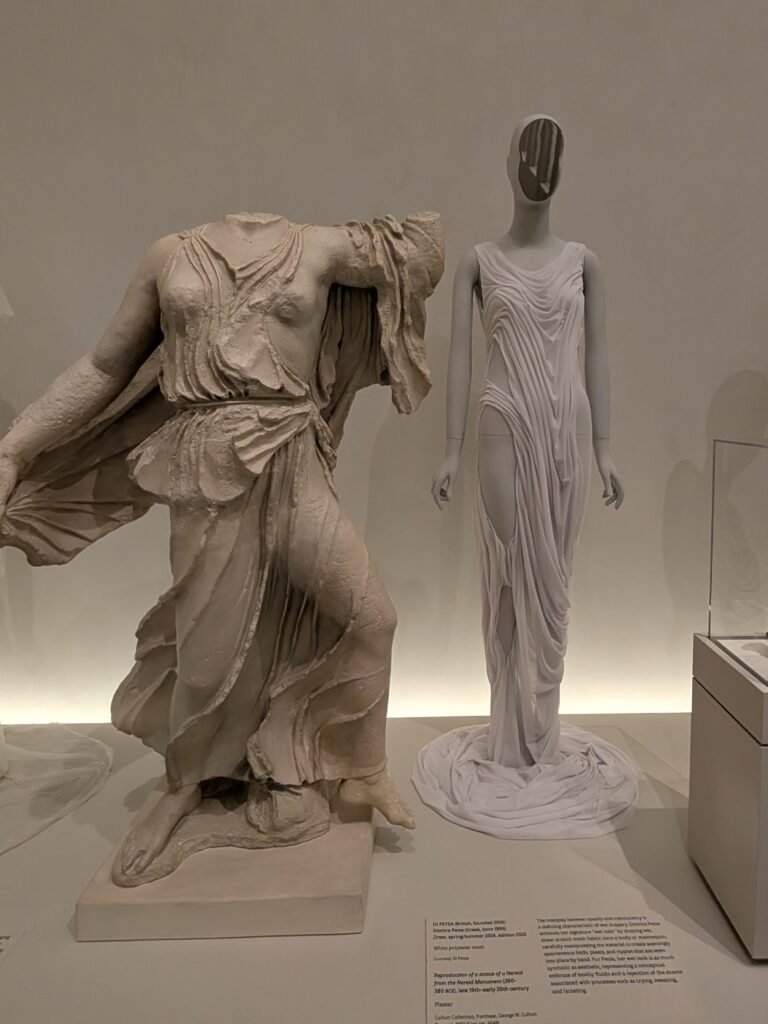
late 19th–early 20th century
Dress
Design House Di Petsa British
Designer Dimitra Petsa Greek
spring/summer 2024, edition 2025
In Di Petsa’s 2024 “wet” dress, this technique takes on a whole new meaning. Dimitra Petsa drapes moist mesh directly over the body or mannequin, locking each ripple and fold in place by hand. For her, this is a manifesto of bodily acceptance and a rejection of shame surrounding natural bodily fluids.
Here, “wet” fabric no longer forces the body into a rigid ancient mold. Instead, it honors the body as living, real, and vulnerable.
From a Simple Rectangle to a Gown
Many ancient garments began with astonishingly simple geometry: a flat rectangle of woven fabric folded, pinned at the shoulders, and cinched at the waist.
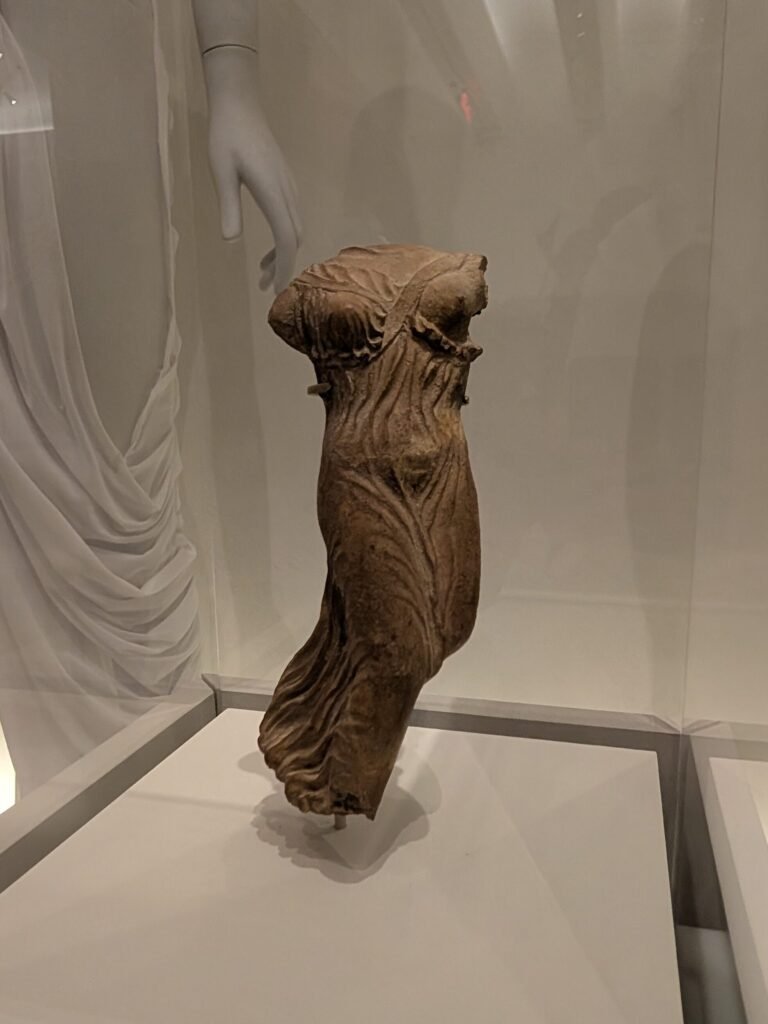
Greek
late 5th century BCE
Both the chiton and peplos are fundamentally rectangles. Yet this mathematical simplicity inspired some of the most elegant gowns of the 20th century.
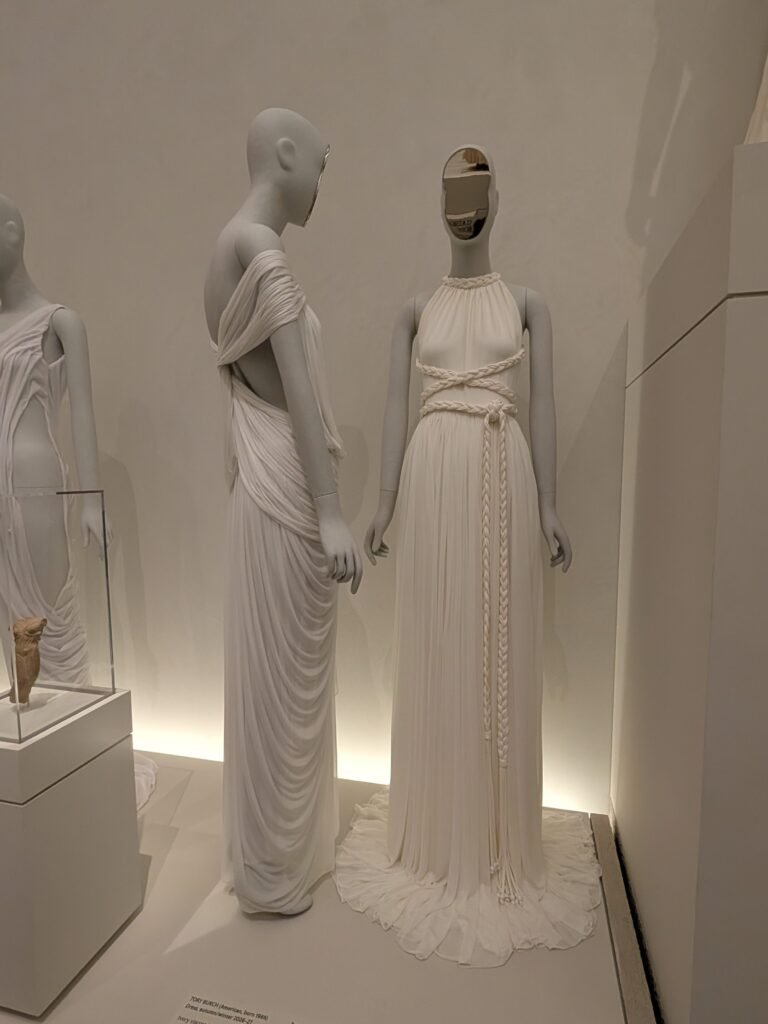
Design House Tory Burch American
Designer Tory Burch
fall/winter 2026–27
For doll clothes makers, this serves as a wonderful reminder: sometimes the most complex and breathtaking silhouette starts not with intricate patterns, but with understanding how a simple rectangle of cloth falls over a figure under its own weight.
Exposed Skin as a Structural Element
A delicately exposed sliver of skin can carry far more expression than complete nudity. This technique recalls ancient Greek vase paintings, where a light cloak does not conceal the body, but makes its underlying contours more pronounced.
The ancient Greek one-shoulder tunic, historically worn by hunters, goddesses, and Amazons, instantly evokes a classical silhouette.
The key here is avoiding blind imitation. Modern couture requires only a single draped line, an bare shoulder, or an asymmetric cut to define the spirit of an entire form.
When the Body Becomes Armor
In another dimension of the exhibition, the classical body turns into armor. Ancient Greek and Roman cuirasses molded muscles and ribs directly onto bronze, ensuring warriors appeared superhuman, powerful, and protected.
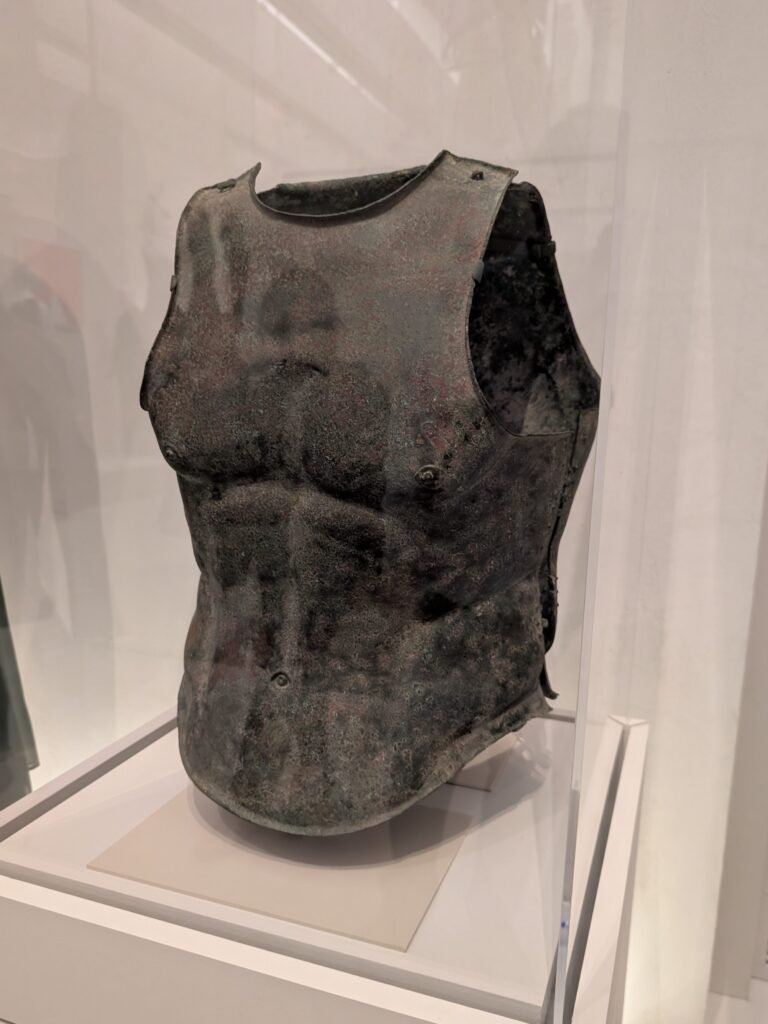
Greek, Apulian
4th century BCE
These rigid shells tease the imagination: they promise ultimate strength while freezing the form in place. For a maker, this is an exciting realm for experimenting with hard structures, where molded bodices and structural corsetry become independent sculptures.
The “Ideal” Body Is Not a Neutral Idea
Ancient harmony and mathematical proportions were never truly neutral.
The “Classical Body” is merely the opening chapter. Subsequent sections of the exhibition move away from frozen canons to address pregnancy, aging, disability, and lived experience, bodies that cannot be reduced to a single formula.
A Maker’s Perspective
The “Classical Body” leaves us with a vital lesson: any ideal is simply a construction. Whether we are looking at an ancient Greek chiton folded from a single fabric panel, Fortuny’s fine pleats, or a flexible corset that adapts to a changing figure—behind every symbol lies pure craftsmanship: managing proportion, tension, and volume.
Classical aesthetics teach us to view fabric not as a mere cover, but as a sculptor’s medium. And the true magic begins when rigorous pattern engineering meets a real, changing, living human being.