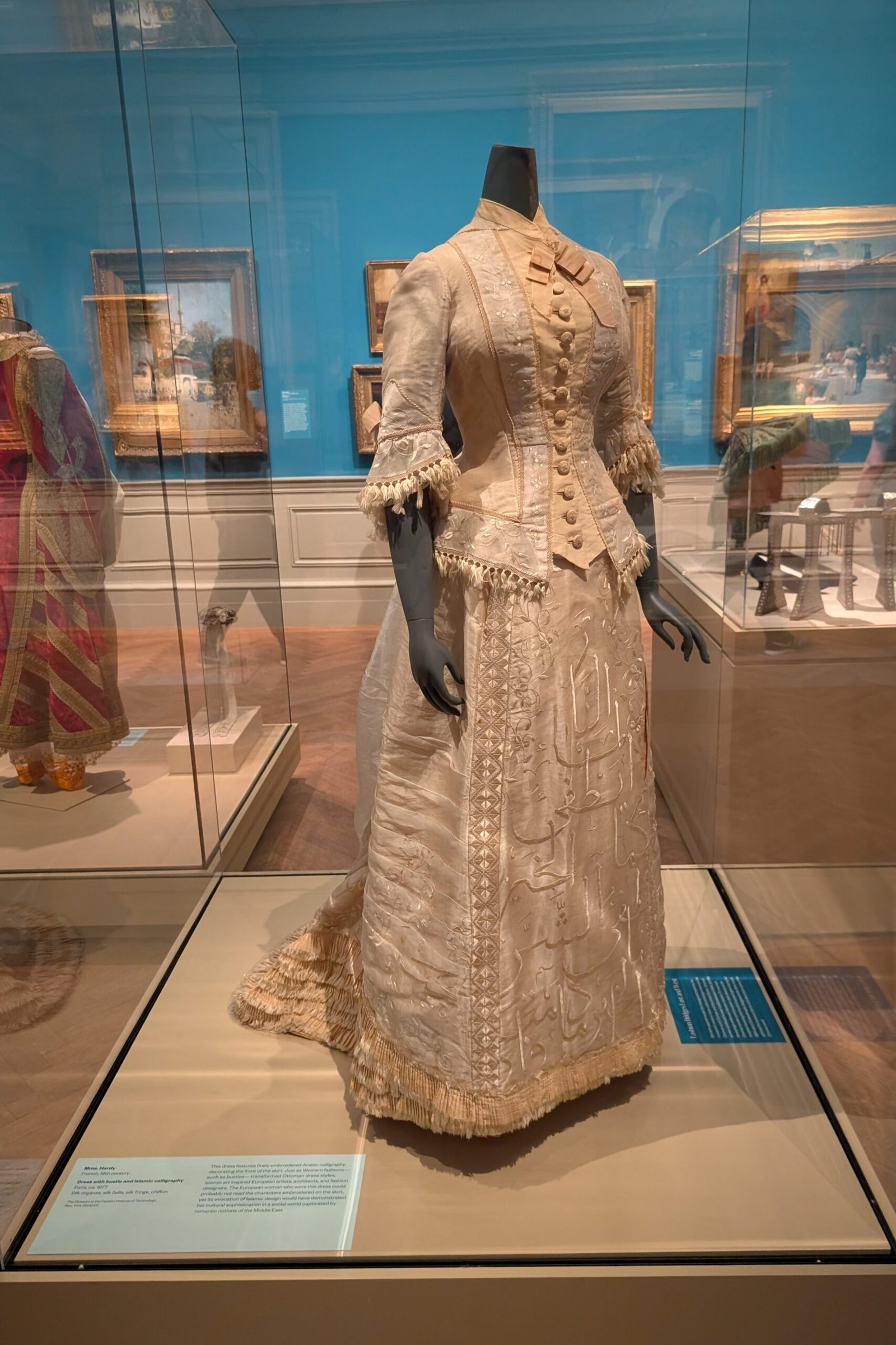

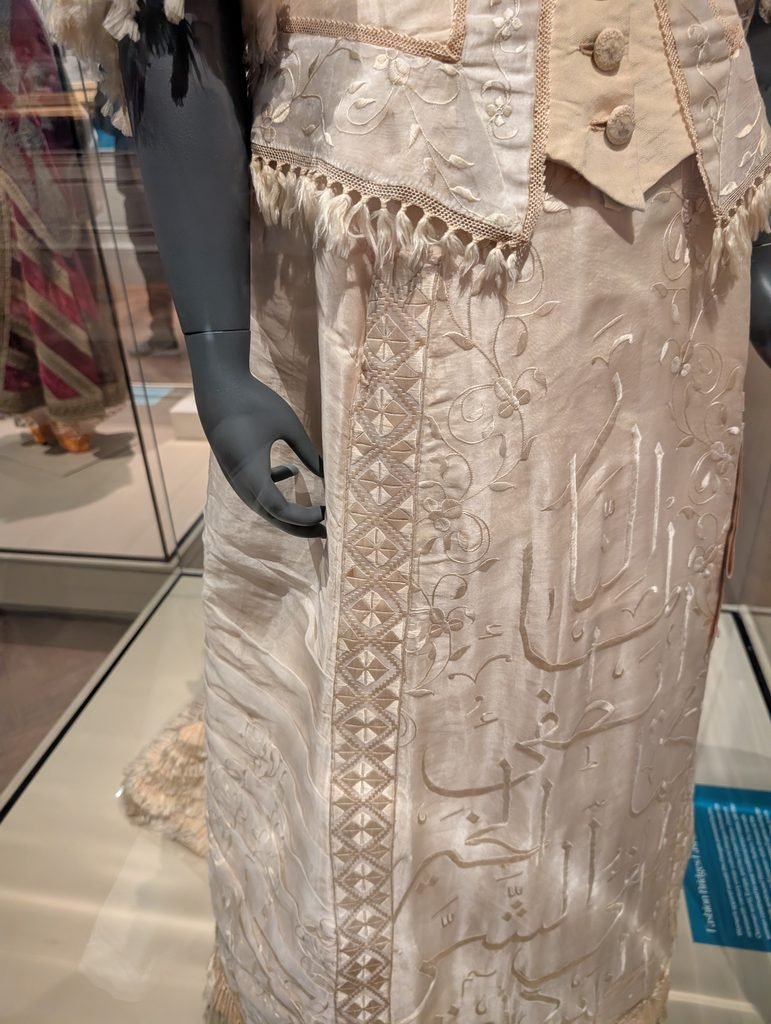
With this gown, your eyes are immediately drawn to its exquisite Parisian silhouette. A perfectly tailored bodice, a neat, dense row of buttons, playful fringe along the sleeves and hips, and a long skirt that flows seamlessly at the back into intricate drapery and a sweeping train. But as you step closer, your gaze catches something truly extraordinary on the front apron of the skirt: amidst delicate embroidered lines emerges something quite unusual for a 1870s European ensemble, Arabic calligraphy.
According to the museum label, the dress was created in Paris around 1877 under the label Mme. Hardy. It elegantly combines cream silk organza, yellow silk faille, silk fringe, and airy chiffon. This piece is displayed at The Metropolitan Museum of Art as a special loan from the collection of The Museum at FIT (Fashion Institute of Technology) in New York.
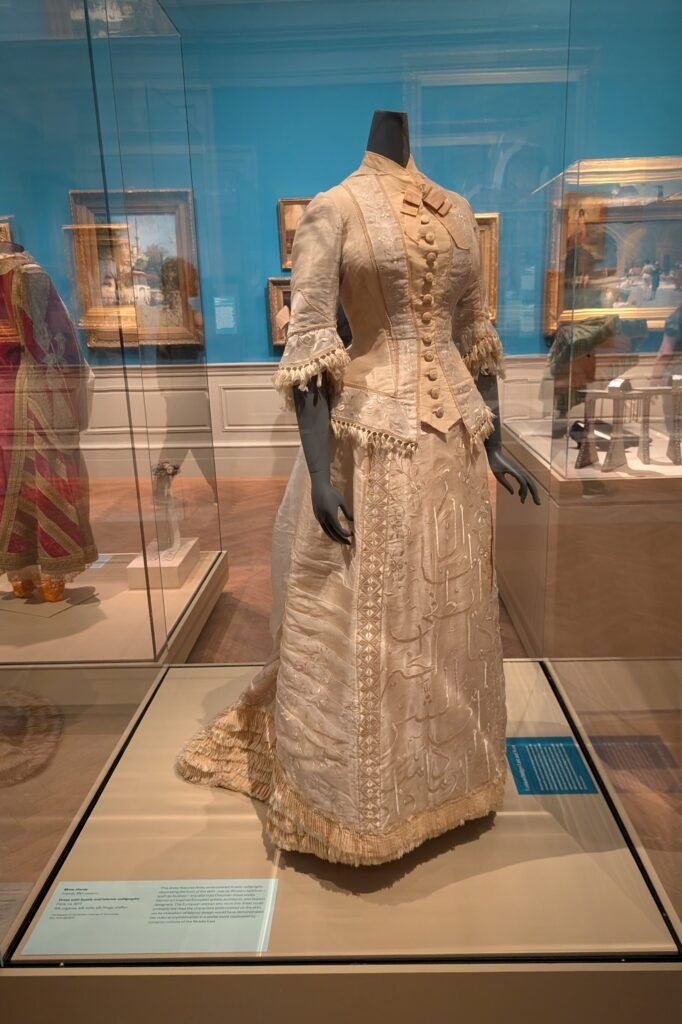
Dress with bustle and Islamic calligraphy
Paris, ca. 1877
Silk organza, silk faille, silk fringe, chiffon
The Museum at the Fashion Institute of Technology.
New York
Examining the Construction and Details
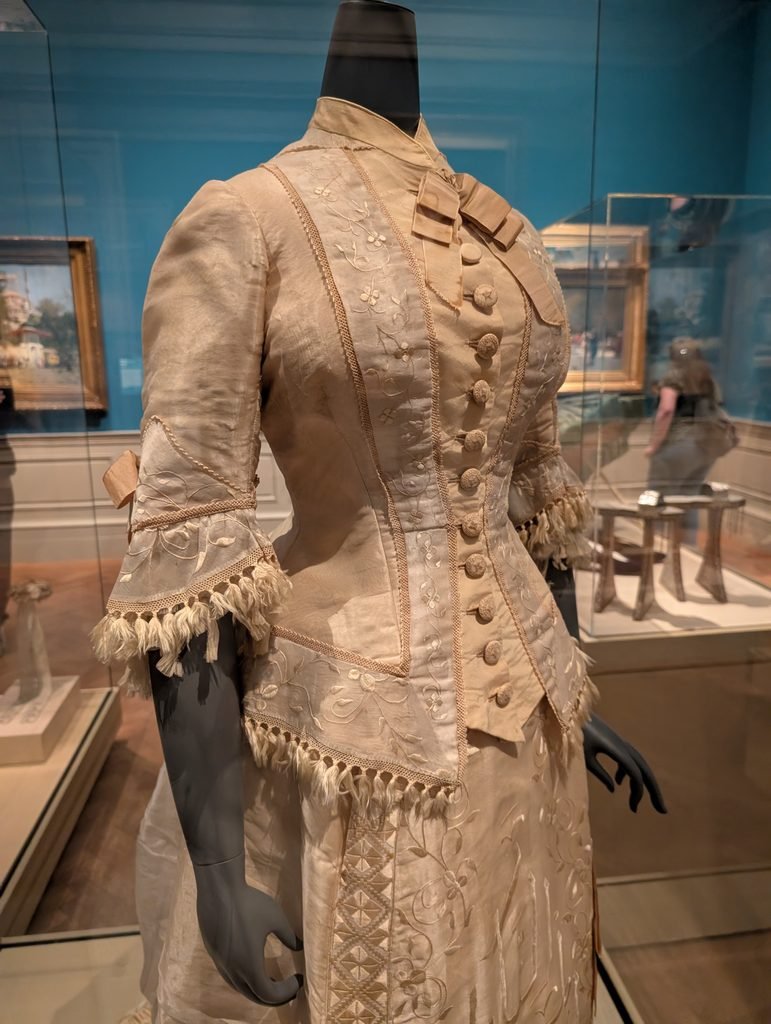
The Parisian bodice is a masterpiece worth examining from every angle:
- Front View: A high collar, beautifully finished edges, and a long, neat row of fabric-covered buttons. The lower edge forms a fitted basque with elongated points resting gently over the skirt.
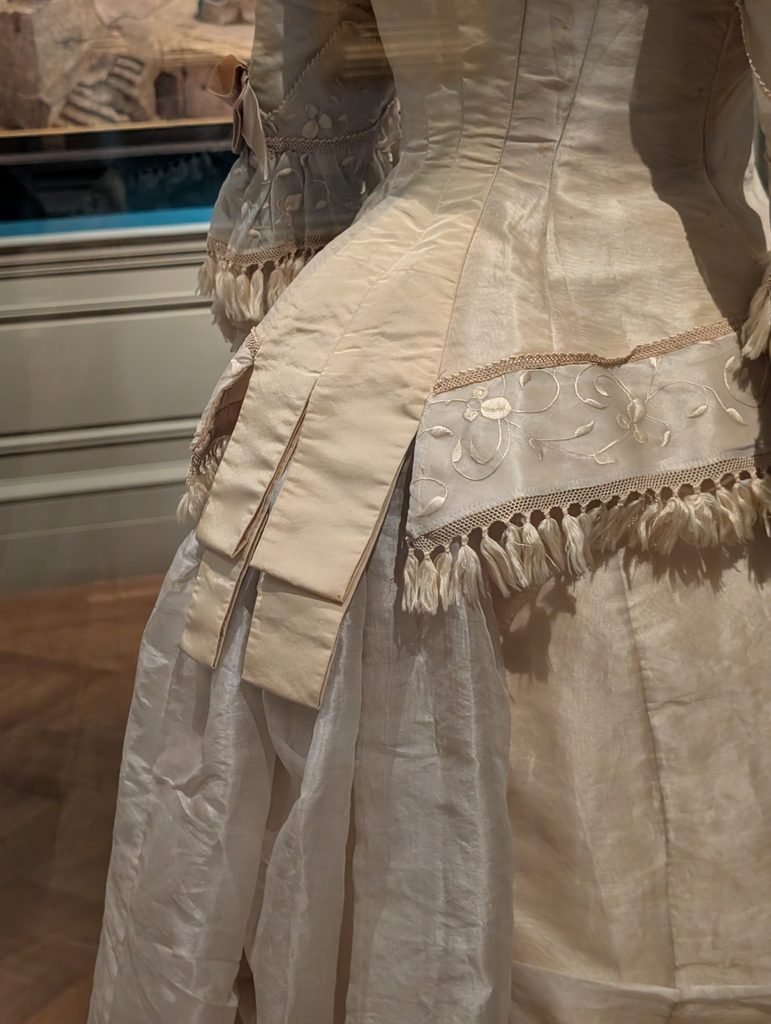
- Sleeves & Hips: Three-quarter sleeves terminate in a band of embroidered trim and fluffy silk fringe, a motif that repeats rhythmically below to frame the hips.
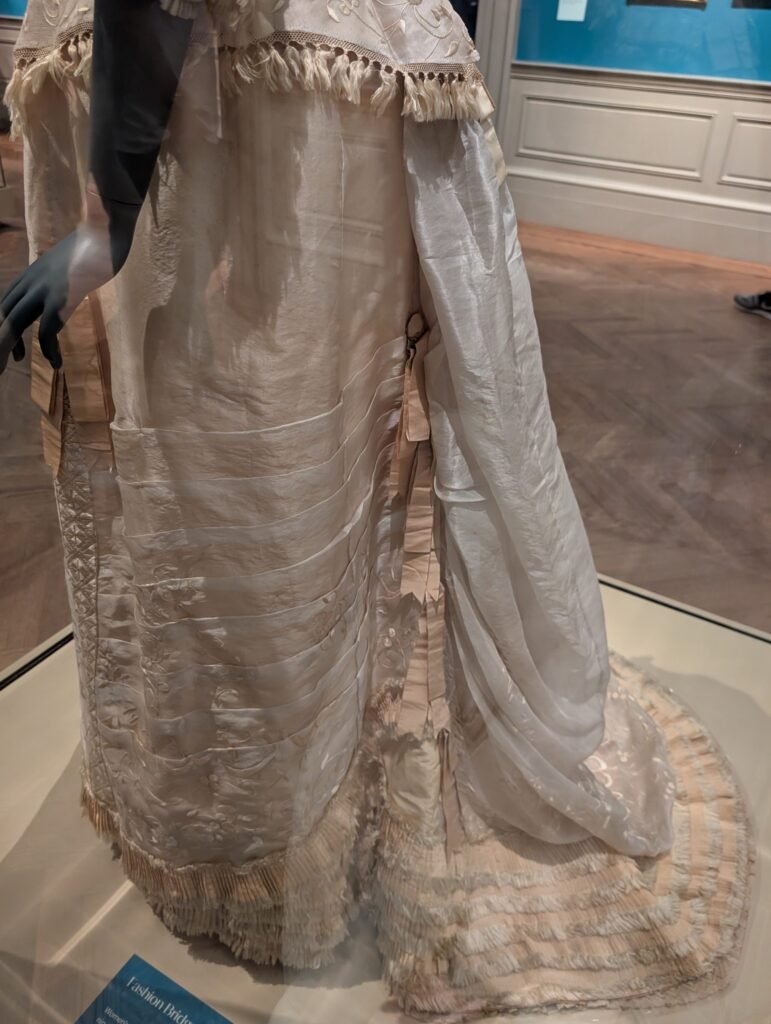
- Back Profile & Train: From behind, the bodice impeccably sculpts a narrow waist. Below begins a true architecture of fabric: cascading folds, overlapping tabs, and long chiffon drapery streaming all the way down to the train. Thanks to the fringe defining each boundary, all these layers read distinctly, even within a close cream-and-yellow palette.
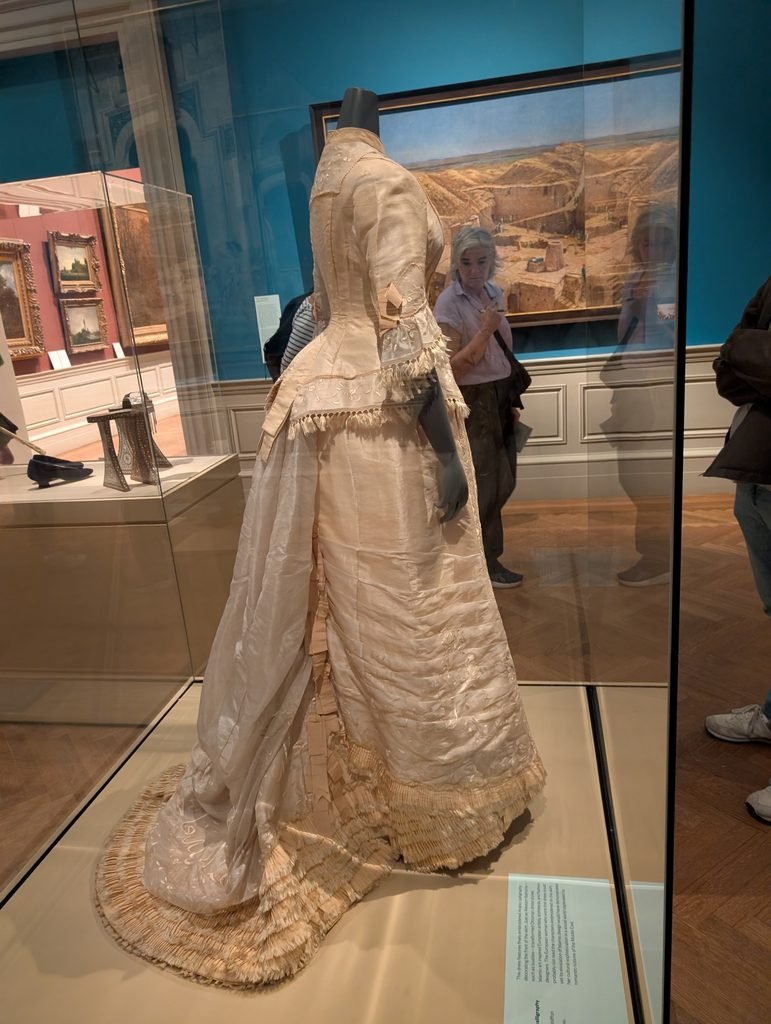
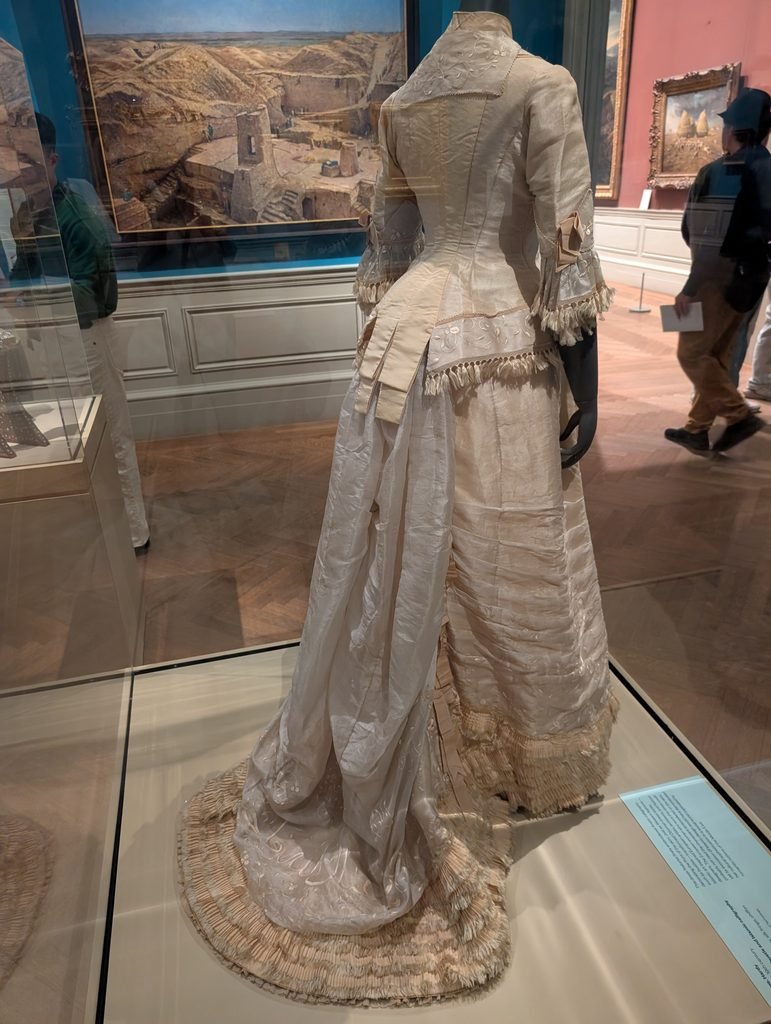
Dress with bustle and Islamic calligraphy
Paris, ca. 1877
Silk organza, silk faille, silk fringe, chiffon
The Museum at the Fashion Institute of Technology.
New York
Script Transformed into Decorative Art
Yet the most captivating secret of this gown lies on the front panel of the skirt. Here, the embroidery doesn’t merely create a standard floral or geometric pattern: the museum description identifies these stitched motifs as Arabic calligraphy.
As curators note, the Parisian owner of this dress was likely unable to read the embroidered characters. However, the presence of these symbols carried immense significance regardless of literacy: they referenced Islamic art and signaled refined taste and cultural awareness within a high-fashion society enchanted by Orientalism, a romanticized fascination with the Near East.
Dress with bustle and Islamic calligraphy
Paris, ca. 1877
Silk organza, silk faille, silk fringe, chiffon
The Museum at the Fashion Institute of Technology.
New York
This creates a fascinating boundary between text and pure visual art:
- For someone fluent in the language, the calligraphy represents explicit words.
- For someone who cannot read it, the rhythmic curves, fluid lines, and compositional harmony of the characters take center stage.
While the museum text does not provide a translation of the inscription, the presence of Arabic script on a Parisian couture dress from 1877 speaks volumes about the diverse inspirations behind late 19th-century fashion.
Paris Looks East, and Vice Versa
Metropolitan Museum curators highlight that these cultural and artistic influences flowed in both directions. Western silhouettes, specifically structured bustles and fitted corsets, were actively transforming Ottoman dress styles during this period. Simultaneously, Islamic ornamentation, architecture, and decorative arts deeply inspired European painters, architects, and Parisian dressmakers.
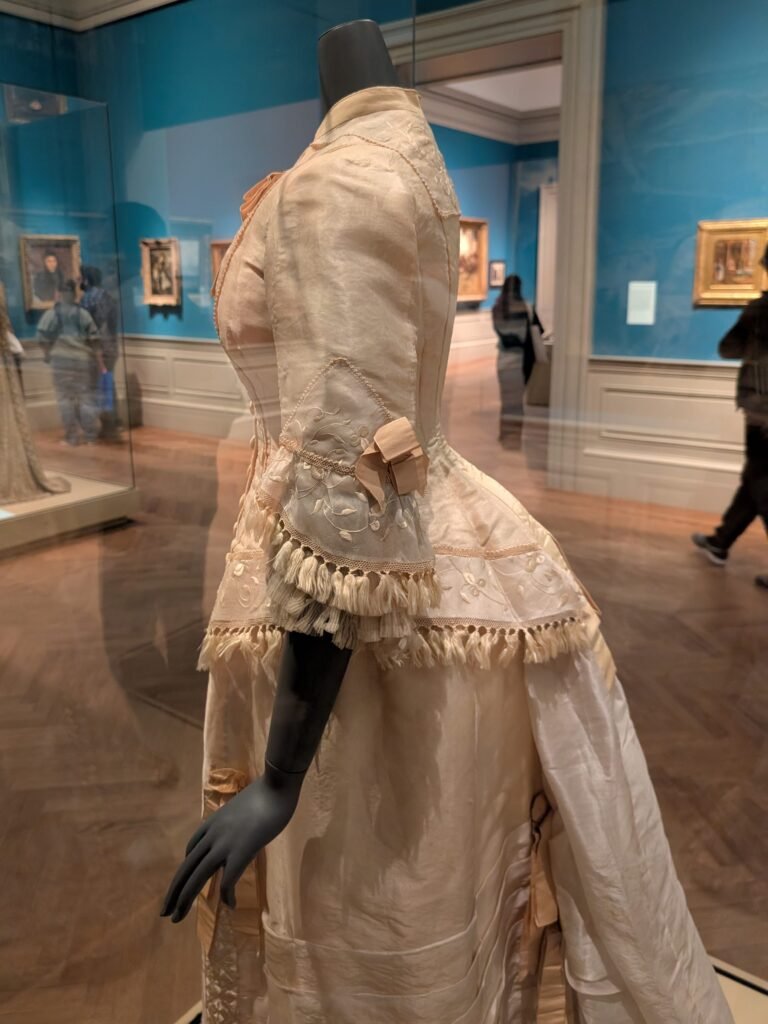
Dress with bustle and Islamic calligraphy
Paris, ca. 1877
Silk organza, silk faille, silk fringe, chiffon
The Museum at the Fashion Institute of Technology.
New York
In this gown by Mme. Hardy, these two worlds merge into a single artistic statement: a monumental Parisian bustle silhouette in the back harmoniously paired with Eastern calligraphic embroidery in the front.
The wearer could admire the aesthetic beauty of the script without reading it, while her peers interpreted the mysterious characters as a sign of cosmopolitan sophistication.
What I Look at as a Doll Clothes Maker
For a doll clothing artisan, this dress is a treasure trove of technical inspiration!
- Miniature Fringe: In doll scale, standard fringe can easily look bulky or oversized. To capture Mme. Hardy’s delicate effect, fine silk embroidery thread or micro-lace with a delicate tasseled edge works best.
- Textural Layering: Combining cream organza, chiffon, and silk faille creates a voluminous bustle without adding excessive stiffness. In doll scale, lightweight chiffon is essential for achieving that weightless train drape seen on the back.
- Micro-Embroidery: Recreating calligraphic script on a miniature skirt is a thrilling challenge! Single-strand silk backstitching or fine silk painting with an ultra-thin resist would allow you to capture these fluid, graceful lines in scale.
Object Details
- Designer / Label: Mme. Hardy
- Date & Origin: Paris, ca. 1877
- Medium: Cream silk organza, yellow silk faille, silk fringe, chiffon
- Credit Line: Collection of The Museum at FIT, New York (On loan to The Metropolitan Museum of Art)
- Accession Number: 83.16.10
- Documentation: Based on museum labels, exhibition text, and The Met’s online catalog materials.